















Mammut Building Systems – a leading manufacturer of pre-engineered steel buildings (PEBs) and polyurethane injected sandwich panels (PUPs) in the UAE – has kicked off an ambitious expansion at its Hamriyah facility in Sharjah, which will significantly enhance the company’s production capacity.
According to a Dubai-based company spokesman, the move will increase Mammut’s capacity to manufacture frames from 3,000 tonnes to 4,500 tonnes per month and increase total production capacity (including secondary members, single skin cladding and sandwich panels) from 5,000 tonnes to 7,500 tonnes.
Work on the expansion, which began this January, is expected to allow Mammut to reach its new target capacities by July.
“A majority of the equipment required for the expansion has already been ordered,” says the spokesman.
Mammut is quite optimistic of its strength in the PEB and PUP markets in the region and intends to maintain its share in the key markets – especially the UAE.
The expansion is part of the company’s plans for improving its market share in the region and also to keep pace with the rising demand for PEBs.
“By the third quarter of 2004, we were faced with capacity constraints as the size of the PEB market in the UAE, in particular, and in the region, in general, began to expand much more rapidly than had been forecasted. During the past four months, Mammut has had to considerably lower its orders intake and has successfully reduced its backlog to manageable levels,” he says.
In addition, the company has infused plenty of experience in its management cadre through recruiting the best talents available. “Over the past three years, the company has successfully recruited the most experienced management in this industry in this region and has succeeded in capturing 65 per cent of the UAE’s market for PEBs.
Mammut says it is the only PEB/PUP manufacturer in the UAE that maintains its own erection staff and has 200 erectors in Dubai and the Northern Emirates and 100 erectors in Abu Dhabi.
“Our supply-and-erection option is popular among general contractors who are unfamiliar with PEBs because Mammut has transformed these general contractors into specialised building system contractors by taking the full responsibility and accountability of the pre-engineered steel buildings from them,” says vice president Muayyad Khudairi.
“The option is also popular with owners of large projects who want to realise savings by entering into direct contracts with specialised contractors.”
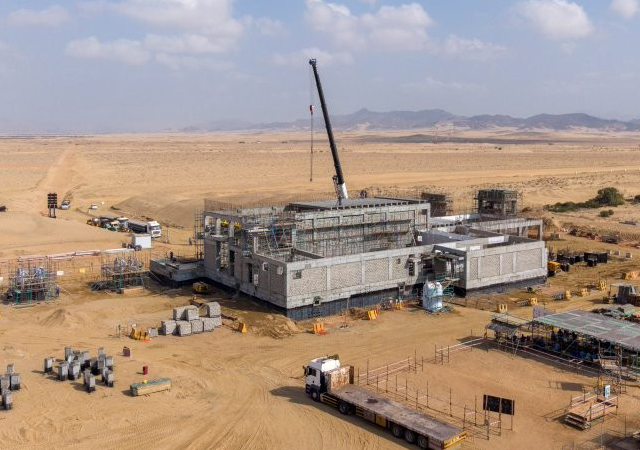
Mammut has successfully executed several major projects in the GCC, Pakistan and Bangladesh. Major projects include the 250,000 sq m Adpico factory in Mussafah, Abu Dhabi; the 223,000 sq m Textile City in Aweer, Dubai; the 37,000 sq m Arabian Pipes factory in Jubail, Saudi Arabia; and the 69,000 sq m RAK Ceramics in Ras Al Khaimah, in addition to numerous other projects.
Adds Khudairi: “Mammut’s customers have praised us for the absence of engineering errors in our finished product.
“The Bocad system used by us is the best steel detailing software in the world and we have invested heavily in its development. This has made Mammut PEBs the favourite among steel building erectors.”
“Mammut has an edge over other regional PEB manufacturers because of its substantial capacity for producing PUPs where its monthly production capacity exceeds 180,000 sq m,” says Khudairi. “This is more than the combined capacity of all Mammut’s PEB competitors. “Furthermore, Mammut is also the only PUP manufacturer in the region that always maintains a three-month inventory of polyester-prepainted AluZinc -coated steel coils and aluminum coils in four colours and two thicknesses. Mammut’s delivery of PUP orders that specify its standard inventory is the fastest in the region. Mammut offers six profiles for the exterior skin (three high rib and three low rib) and four profiles (three low rib and one flat) for the interior skin - again giving its customers the widest choice in the industry,” he adds.
“The PEB system is the most economical building system in the world for the construction of industrial, distribution and aviation buildings as it uses a limited number of inventory items to produce an infinite range of custom buildings for every conceivable function,” the spokesman concludes.