









In a bold attempt to resolve its ever-increasing problems of traffic congestion and to add more variety to its skyline, the Dubai Municipality has launched one of the most ambitious transport scheme ever to be built in the region – the Light Rail Project.
Construction work on the project that is expected to allow state-of-the-art coaches to skim at a height of seven metres over most of Dubai is expected to start next month.
The project – which was earlier slated for completion over the next 10 years – has been fast tracked with the first phase to be ready by 2009, and according to a spokesman for the Dubai Municipality, “Once complete, the project will be one of the most advanced urban rail systems in the world and could spur tourism, financial and economic growth.”
“Enabling works have already started for the future Green Line terminus at Dubai International Airport, in connection with the construction of Terminal 3, both of which are due to be completed by the end of this year,” says the spokesman.
The Dubai Municipality opened bids for the first phase in February. Of the four bids that were received, Dubai Rapid Link – a consortium of Turkish Yapi Merkezi, and Japanese companies Obayashi, Kajima, and Mitsubishi – presented the lowest bid of $1.8 billion.
Dubai Star Consortium, which includes Alstom (France), Belfinger Berger (Germany) Taisei (Japan), Besix (Belgium) with Orascom(Egypt) and Al Habtoor (UAE), quoted Dh8.854 billion, while Salsabeel, consisting of Siemens (Germany), Saudi Bin Ladin Group (Saudi Arabia), Dywidag (Germany) and Citic Group (China) quoted Dh8.922 billion and Metro One, which consists of Bombardier (Canada), Odebrecht (Brazil), Arabtec Construction (UAE), and Parsons Transportation Group (US) quoted Dh10 billion.
Qassim Sultan, director general of Dubai Municipality and chairman of the Higher Committee of the Dubai LRT, noted that the offers were preliminary and that a technical team comprising members of the project consultant, Systra, and the LRT committee, would evaluate the offers technically, financially and contractually before announcing final winners of the project shortly.
Investors winning the first stage of the tender reportedly will stand a high chance of winning the tender for construction of second stage of the metro as well, which together are worth some $3.5 billion.
Technical bidding for the 70-km network that will wind through the nerve centres of Dubai has been split into separate sections covering the civil works, electromechanical systems and supply of rolling stock.
“With the introduction of Dubai Metro, the market share of public transport including buses and LRT, is projected to rise from the current five per cent to 17 per cent by 2020. The new policies and regulations will take this further to 26 per cent by the target year,” Sultan says.
He adds that this modal shift would help de-congest roads, decrease traffic hold-ups and increase road safety. Besides, the metro will also improve air quality and the total health care costs attributed to air pollution will decrease approximately by a million dirhams per year.
The first phase of Dubai LRT project, which would cover 35 km from Rashidiya to the American University in Dubai (AUD), is expected to be completed by May 2009. The 32-km second phase from AUD to Jebel Ali would be over by May 2012. It will have two lines with the 51-km Red Line taking 66 minutes at a speed of 46 km per hour and the 16-km Green Line taking 29 minutes at a speed of 33-km per hour. A third – Blue line – is also on the cards.
The trains will carry as many as 23,000 passengers per hour per direction with a possible expansion to 27,500 passengers in future. By 2010, some 760,000 passengers are expected to use the train daily, which will grow to 1.95 million passengers by 2020.
Metro Transit System
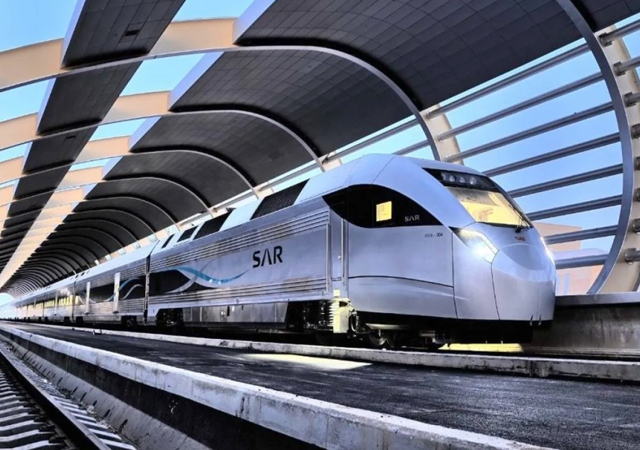
The Dubai Metro System will be built around top-of-the-class modern trains, fully air-conditioned and customised to meet Dubai's specific requirements. Each train will be approximately 75m long, consisting of five cars, with numerous double doors allowing fast and smooth flows of passengers in station.
The trains will offer a standard class, affordable to all, a women and children’s section as well as an exclusive first-class section. All sections will have a high proportion of seats, and be equipped with a state-of-the-art passenger information system.
The driverless and fully automated trains will offer an extremely safe and reliable service and could run as often as one every 90 seconds, with extensive window panels providing stunning views from the elevated sections over the cityscape.
The trains have an electrical traction system, which is environmentally friendly. No visually intrusive overhead contact lines will be needed. The trains will use steel wheels or tyres (to be defined later) running on a special double track for full guidance and support.
All stations will be equipped with platform screen doors, ensuring optimal safety for passengers and allowing full air-conditioning all stations – whether elevated or underground.
Metro Network
The Dubai metro network will comprise two lines:
The Red Line will initially run from Salahuddin Road (close to Al Ghurair Centre) to the American University of Dubai through BurJuman and Sheikh Zayed Road, and will progressively be extended to Jebel Ali Port in the south and the intersection of Al Nahda and Damascus roads through Al Qiyadah intersection in the north;
The Green Line will initially run from Al Ittihad Square (close to the Municipality) to Rashidiya bus station through Deira City Centre and the Airport Terminals 1 and 3, and will progressively be extended to serve the Deira and Bur Dubai central areas and suq up to Burjuman and Wafi shopping centres.
The two lines will extend across a total of nearly 70 km, with 35 stations along the 50-km long Red Line, and 22 along the 20-km long Green Line. The two transfer stations at Al Ittihad Square and Burjuman are common to both lines.
A possible extension of the Green Line from Wafi to the projected Festival City development is under study.
The two lines will run underground in the city centre: The Red Line from the intersection of Sheikh Rashid and Sheikh Khalifa Bin Zayed roads to just before the intersection of Salahuddin and Abu Bakr Al Siddique roads; and the Green Line from Garhoud to Oud Metha Road
The two lines will run elevated on a specially designed viaduct everywhere else. The viaduct design and aesthetics is being developed specifically to enhance the urban architecture along its corridor. In no location will the tracks cross the public highway, ensuring fully safe mode segregation.
Following the completion of the Red and Green lines, Dubai Municipality intends to proceed with the Blue Line.
“The Blue Line is designed to perform two functions: On the one hand, it will be a link between the current Dubai International Airport and the proposed Jebel Ali Airport, while on the other, it will be a service for the areas located between the terminals. That’s why we are studying the feasibility of a three-track line, with one of the tracks directly linking the two airports. Furthermore, we will be drawing up a master plan oriented towards needs of mass transit. The plan will be ready by the end of 2005,” says the spokesman.
Integrated public transit network
The metro network will be fully integrated within the overall public transit network operated by the Dubai Municipality Public Transport Department. Bus routes and stops will be organised around the backbone provided by the rail system, extending its reach into all communities in Dubai. Taxi stations and park and ride facilities will be included in key metro stations to further enhance the central role of the metro system.
Fare policies and collection systems will be common to the bus and rail networks, allowing seamless travel across the Dubai Public Transit network.
“The Dubai Metro will be the most advanced urban rail system and its perfect and well planned integration in the city will contribute to the unique image of the emirate in the world,” says a spokesman. “It constitutes a major step forward its future development. The Dubai Public Transit network will become the backbone for the touristic, financial and economic growth,” he adds.
Costs & revenues
Investment costs for the full Dubai Metro System are assessed at a grand total of about Dh14.3 billion, including civil works, stations, system fixed equipment, trains, engineering and financing.
The operating cost of the project is expected to run up to Dh570 million per year, including staff, maintenance, and power consumption. This operating cost is planned to be easily met through fare box revenue and additional revenues derived from advertisement space, joint development or other sources which may be assigned by the Dubai Municipality.