









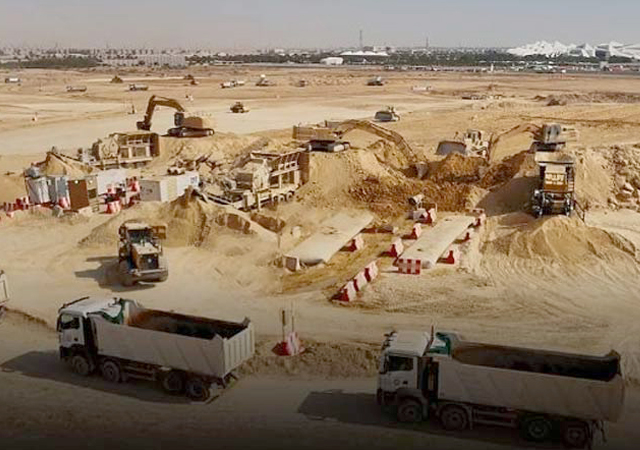



Saudi-based steel manufacturer Saudi Iron and Steel Company (Hadeed) has recently secured a major supply award through its UAE distributor Cicon for the supply of rebar for the Dubai International Airport expansion project.
The award signed between Cicon and Al Naboodah, requires Hadeed to supply 87,000 tonnes of steel for the earthwork and piling phase. project is expected to consume a total of 140,000 tonnes of rebar.
“It is a remarkable event as it is the biggest order in the UAE with respect to steel consumption,” says a spokesman. “It is Hadeed’s largest order and also the first order whereby the company will be rolling out rebars with a length of 18.25 m.”
Hadeed is currently upgrading its long products output to three million tonnes annually, which entails:
- Upgrading automation and control systems in the bar and rod mills – expected to be complete by the year-end;
- Upgrading a cooling system in the wire rod mill and application of a state-of-the-art computer-based cooling technology that provides added value products – also due to be complete by the year-end;
- Installing a new 700,000 tonnes per year (tpy) wire rod and bar mill - expected to be complete by end of 2006;
- Installing a three/four way slitting machine – feasibility study under way; and
- Installing an endless rolling system in the section and bar mill – feasibility study under way.
Hadeed rolls out a range of long products, flat products ranging from hot rolled, cold rolled and galvanised coils; byproducts including 3 to 6 mm iron oxide fines, red oxide, slurry fines, 36 mm oxide fines and slurry, in addition to offering a host of workshop services.
Wholly owned by Saudi Basic Industries Corporation (Sabic), Hadeed - the first fully integrated steel producer in Saudi Arabia - started producing rebars and wire rods in 1983, in Jubail Industrial city.
In 1986, Hadeed introduced slit rolling to its rolling mills bringing about a significant 21 per cent increase in its daily production. A year later, it commissioned a scrap car shredder plant with a capacity of 50 tonnes per hour that could easily shred cars into pieces small enough to be charged into the electric arc furnaces.
Keeping up with the trend of introducing newer technologies, Hadeed introduced a new technology (bar quenching) to its rolling mills in 1988, for the manufacture of superior quality concrete reinforcing bars. This state-of-the-art process involves high pressure surface quenching followed by self-tempering. As the bar emerges from the last rolling stand, high-pressure water jets rapidly reduce the surface temperature. This action changes the microstructure of the steel, making it harder and stronger. Subsequently the heat retained in the core dissipates out and heats the surface to around 620 deg C, causing another change in the microstructure, which improves the ductility and toughness of the bar.
“The bar quenching process meets the ever-increasing demand from structural engineers for higher yield strength combined with good ductility and weldability in reinforcing steel to reduce construction costs,” says the spokesman.
In 1990, Hadeed commissioned a new de-dusting plant to reduce air pollution resulting from the increase in production and also to meet the requirements of environmental protection of Jubail Industrial City.
Hadeed commissioned a third Midrex 600 direct reduction module in 1992, with a nominal capacity of 600,000 tonnes. In June the same year, an enhancement project to increase the steel plant’s annual production capacity to 2.8 million tonnes was completed. The project included the installation of new steel making units, modifying the material handling, injection and sampling systems and the continuous casting machines.
In 1993, Hadeed’s section and bar mill came on stream with an annual capacity of approximately 500,000 tonnes, adding to its ability to produce sections such as channels, angles, flats and squares.
The process of improving facilities and technologies at Hadeed continued unabated with its 850,000 tonnes capacity flat facility commencing commercial production in July 2000. Situated on a site that is capable of accommodating planned expansions, the new facility will eventually raise the annual production capacity to two million tonnes of hot rolled, cold rolled and galvanised products. The plan includes constructing an additional direct reduction module, an electric arc furnace, a ladle furnace, a steel slab casting machine, a slab-reheating furnace and a finishing mill stand, he says.
Long products
Hadeed’s long products rolling mills include three separate units:
- A single strand bar mill (Mannesman Demag system);
- A rod mill (Schloeman Siemag system); and
- A sections and bar Mill (Danielli system)
The raw material inputs for the bar mill are steel billets, which have 130 by 130 mm square cross sections and are 14 m in length. These billets are also used in the other two mills.
The billets are reheated to the desired rolling temperature and then rolled into rebars of 12 to 40 mm diameter by 12 m as a standard length. Alternatively, they can be produced according to the customer’s preferred length of 12 to 18 m with a standard bundle weight of two tonnes.
The annual production capacity of the bar mill is around 1.2 tonnes of rebars.
In the single strand rod mill, the billets are rolled into wire rod coils and plain and deformed bars, 5.5 to 16 mm in size. The annual production capacity of this mill is around 700,000 tonnes, and it is capable of producing various special types, as may be required by customers. These include wire drawing, mesh and electrode fabrication.
The sections and bar mill has an annual production capacity of over 650,000 tonnes of light sections and rebars.
Flat products
The company’s flat products facility (FPF) - located adjacent to the Hadeed Long Products complex houses: a direct reduction plant; a steel plant; a hot strip mill; finishing facilities; and a cold mill complex.
Hadeed has also made significant investments in new facilities for the production of flat steel products, including: hot rolled products; cold rolled products; and galvanised products.
Hot rolled products include coils, plates and slit rings of commercial, drawing, structural, pressure vessel, API line pipe and high-strength micro-alloyed steel grades, which are 1.5 to 16 mm thick and 850 -1650 mm wide.
Cold rolled products manufactured at Hadeed’s facility include coils and slit rings of commercial, structural, high strength micro-alloyed and drawing steel grades. These products satisfy the requirements of manufacturing companies with respect to product strength, ductility and weldability.
A wide range of galvanised products – coils and slit rings of commercial, lock forming, full hard, drawing and structural grades – that find use in the air-conditioning, refrigeration, pre-painted coating, panels and appliance industries are also manufactured at Hadeed’s facility.
Quality
Hadeed has also maintained a high level of quality in its products. All of the flat products of the company conform to the dimensional and shape tolerances as per American, Japanese, European standards and other specifications. For its commitment for quality, the company also received the International Star Quality Award from the Business Institute Directions (BID) in Switzerland, last year.
The 28th International Star Quality Award Quality Convention aims at recognizing the commitment of every awarded company towards every aspect of quality: the information process, analysis, strategies, continuous training and improvement of systems and processes in communication, both internal and external.
The company has supplied its steel to several impressive projects in the region that include: the Prophets Mosque in Madinah and the Grand Mosque in Makkah, Al Faisaliah Tower and Kingdom Centre in Riyadh, King Fahad Stadium, Hadeed Monument (all in Saudi Arabia), Communication Tower, Kuwait, Burj Al Arab, Jumeirah Beach Hotel, Emirates Towers (all in the UAE).
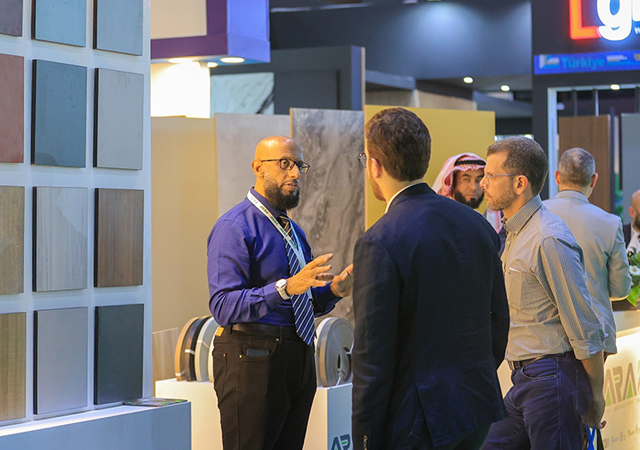
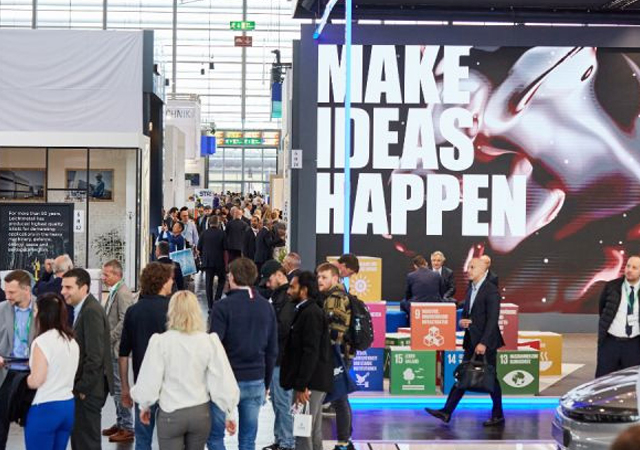
The company has participated in most of the major construction exhibitions in the region, including the Big 5 show in Dubai, SaudiBuild in Riyadh and Saudi Building and Interiors Exhibition in Jeddah and the Qassin Internation Building and Construction Exhibition in Qassim.




5.jpg)
