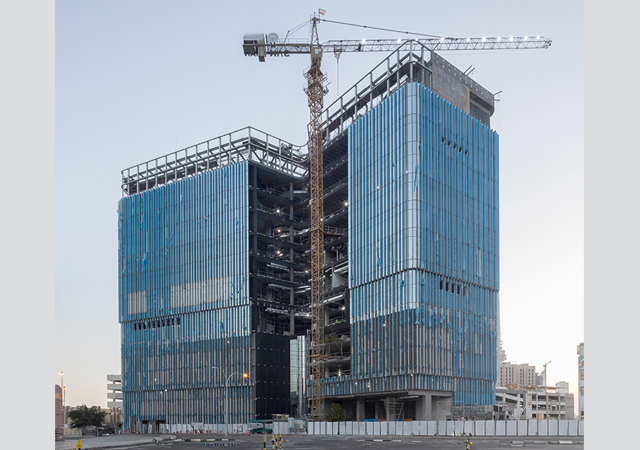





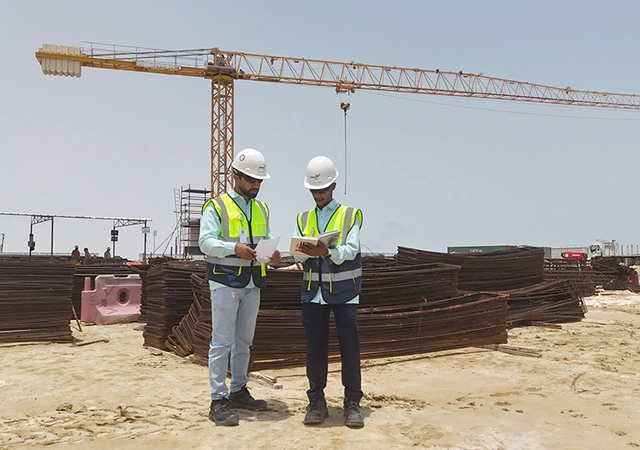
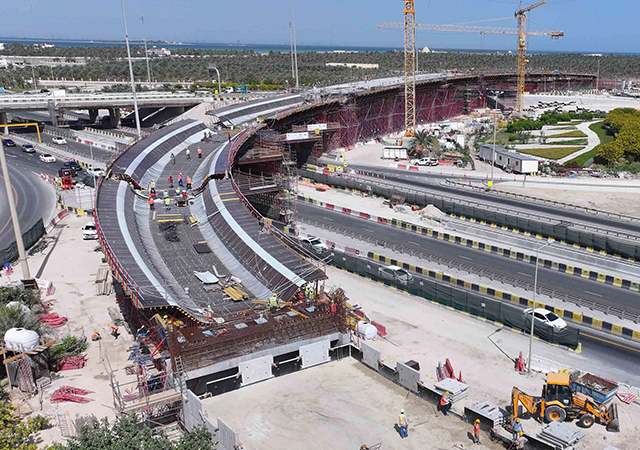





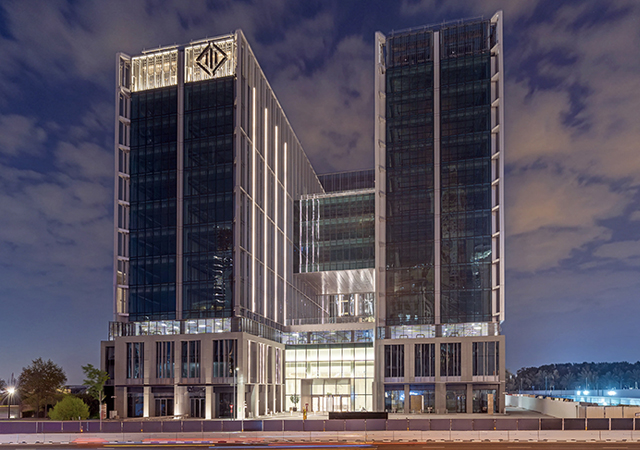




Formwork systems from Doka of Austria are being used to speed up construction work on the superstructure of the new Oil Sector Complex coming up in Kuwait.
The complex which will be the joint central administration complex of the Kuwaiti Oil Ministry and the Kuwait Petroleum Corporation is being built at an estimated cost of 145 million euros (about $128 million).
The building shell, which is budgeted to cost around 25 million euros, is scheduled for completion by August.
By this time, 200,000 sq m of walls and floor slabs will have been formed, and 45,000 cu m of concrete poured, according to details provided by Doka Formwork Systems.
The building shell is being completed using Doka formwork systems. The contractor is a joint venture between Alghanim International and L/G.
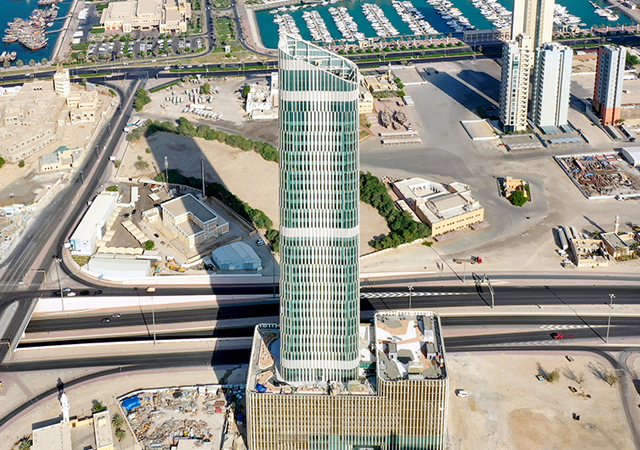
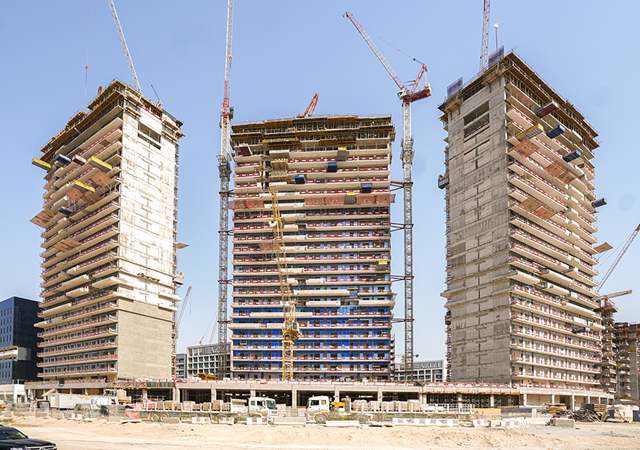
The project comprises two high-rise structures, one of them 17 and the other 21 storeys tall, and a third tower with a semi-elliptical cross-section that houses the stairwell and lift shafts and from which access is provided to the two office towers via aerial walkways.
In addition, a 5,500 sq m podium is being built. The single-storey and two-storey low-rise structure will house a training centre, various technical facilities, and prayer zones. A car-park will also be built at a later stage.
"As the concrete construction operations have to be completed within 14 months, work has to proceed simultaneously on all sections of the structure, that is, on the two office towers, the semi-elliptical tower and the podium," says a spokesman for Doka.
The contractors are building this administration complex using the whole spectrum of Doka equipment, and with wide-ranging Doka planning assistance.
Doka says the following equipment is in use at the complex: 5,200 sq m of Top 50 wall formwork, 14 sets of Top 50 column formwork, 200 units of climbing formwork, 50 different shaft platforms, 5,600 sq m of Dokaflex slab formwork, and approximately 1,000 sq m of Doka load-bearing tower d2 (for shoring heights of up to 10 m).
"Office Towers A and B each contain two cores, consisting of stairwell and lift-shaft groups. These cores are 'climbed' two storeys ahead of the floor slabs, making it possible to 'de-link' operations on the vertical and horizontal parts of the structure and thus saving construction time," he says.
The spokesman continues: "Owing to the size of the two cores for each building, it is not feasible to pour them in one single casting section, and so each core is poured in a staggered weekly cycle.
"The quantity of formwork commissioned here is equal to the total needed for all four cores. In this way, it is only necessary to shift the formwork in the vertical, but not in the horizontal.
"For the outside walls of the triangular zone of the office towers, a complete set of outside formwork has been commissioned, and for the inside walls, a one-half set which is shifted once per storey. The outside formwork of the walls also serves as the perimeter formwork for the floor-slabs.
"In total, there are 2,500 sq m of large-area formwork Top 50 and climbing formwork 150 F and 32 shaft platforms in use for the four cores, and 1,050 sq m of large-area formwork Top 50 and 150 F climbing units for the outside walls.
"The floor-slabs follow in a fortnightly cycle, with sufficient formwork equipment for two complete storeys being commissioned for each of the two office towers. A total of approximately 5,500 sq m of Dokaflex 20 is in use. In the areas that are open to the outside, d2 tableforms are used, for safety reasons.
"The walls of the semi-elliptical stairwell and lift-shaft core are also 'climbed ahead' in their entirety. The floor-slabs and aerial walkways to the two office towers follow approximately two storeys behind.
"Some 650 sq m of Large-area formwork Top 50 is in use here, together with climbing formwork 150 F with trailing platforms and shaft platforms. Here too, work is proceeding in a weekly cycle.
"For the columns, column formwork Top 50 is in use. The advantage of this formwork over steel formworks is the ease with which it can be adapted to various dimensions, simply by exchanging the profiled timber formers. This is particularly advantageous here, as the diameter of the circular columns in the two office towers changes no fewer than three times between the first and final storeys.
"The four cores of the two office towers are both round and conical, yet are each of different shape and size; in addition, there is also the semi-elliptical central stairwell and lift-shaft core to be formed.
"Owing to these architectural complications, over 400 custom elements of Large-area formwork Top 50 were needed. All the profiled timber formers required here were supplied by Doka."
"It has taken very extensive planning work by Doka Kuwait to master the complex logistical challenges presented here," he comments.