



Saudi Entertainment Ventures (SEVEN) opened its first two integrated leisure complexes in Abha and Tabuk last month, marking the operational launch of a 14‑destination, SAR50 billion ($13.3 billion) programme to build a nationwide entertainment network under Vision 2030.
These fully-indoor destinations combine international entertainment brands with Saudi-developed concepts, dining, retail and community spaces, offering a comfortable year-round amusement park.
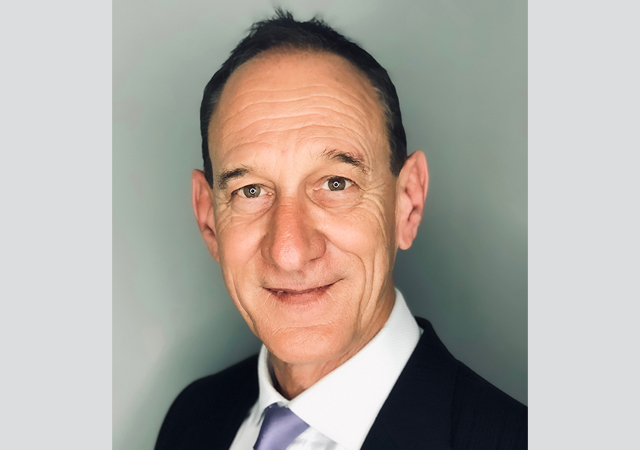
In an interview with Gulf Construction’s Bina Goveas, Abdulelah Alfawzan, Chief Project Delivery Officer at SEVEN, discusses the delivery of SEVEN Abha and the challenges of integrating specialised attractions, immersive technologies and conventional building systems.
SEVEN chose Abha as its first destination because of Aseer’s strong cultural identity, growing tourism base and community demand for family‑oriented experiences, Alfawzan says.
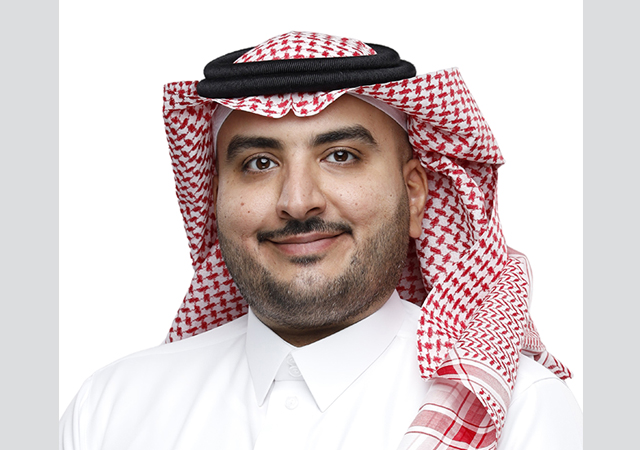
Alfawzan ... bringing distinctive, high-quality entertainment closer to people across Saudi Arabia.
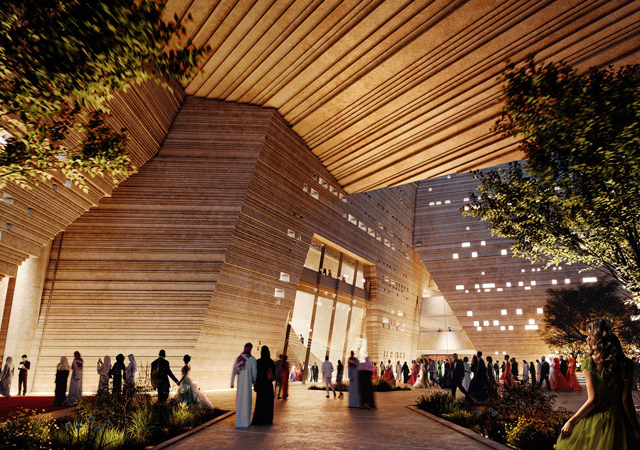
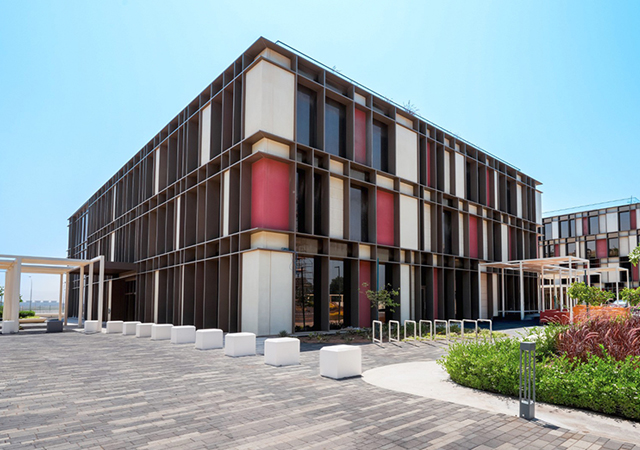
The 70,000-plus-sq-m, fully indoor complex near Abha International Airport blends global entertainment brands with architecture inspired by Aseer’s stone‑built heritage to create a venue that feels “rooted in its location rather than simply replicated from elsewhere”.
He also outlines how the company is managing quality, safety, procurement and commissioning across multiple projects while tailoring each site to local culture and climate, and how lessons from the first wave of developments are being applied across the wider portfolio.
Excerpts of the interview with Abdulelah Alfawzan, Chief Project Delivery Officer at SEVEN:
As SEVEN’s first destination, what makes Abha the ideal location to pioneer your operational era, and how does it embody the “Joy around the corner” mandate under Vision 2030?
Abha is a natural place for SEVEN to begin this next chapter. It is one of the kingdom’s most distinctive destinations, with a strong cultural identity, a growing tourism sector and a community that values experiences that bring families and people together.
SEVEN Abha was designed specifically with that context in mind. The destination brings together world-class entertainment with a design that draws inspiration from Aseer’s heritage, creating an experience that feels rooted in its location rather than simply replicated from elsewhere.
More broadly, it brings to life our ambition to make high-quality entertainment more accessible to communities across the kingdom. SEVEN’s role is not simply to develop attractions, but to create destinations that enhance quality of life, generate economic opportunities and contribute to the development of a sustainable entertainment sector in line with Vision 2030. Abha is the first physical expression of that ambition and an important milestone in SEVEN’s wider national rollout.
What are the headline attractions and experiences unique to Abha, and how do they differ from Tabuk and Al Hamra?
Each SEVEN destination is developed around its local market, community, and character, while maintaining the same commitment to quality and guest experience across the portfolio.
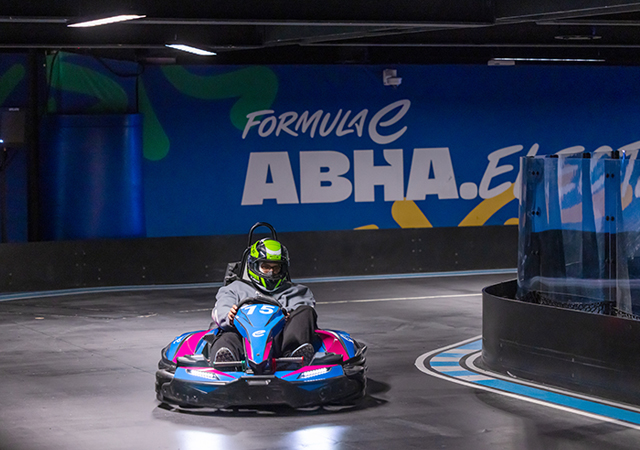
The Formula E Karting experience combines electric karting with immersive technology and Formula E-inspired content.
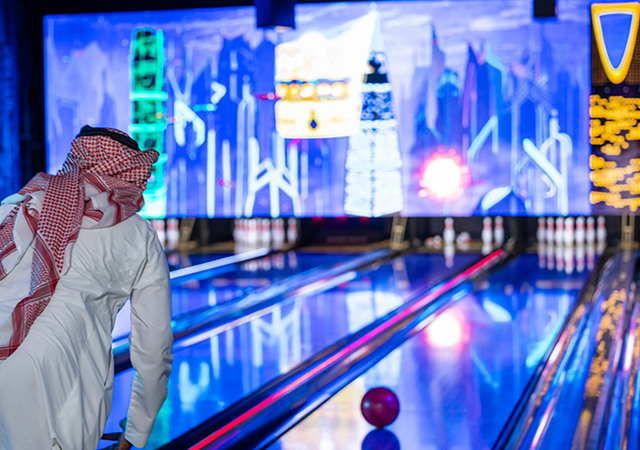
In Abha, guests can experience a diverse mix of global and homegrown entertainment concepts. SEVEN has partnered with renowned global brands and IP partners, including Warner Bros. Discovery, Hasbro and Formula E, to bring distinctive entertainment experiences to the kingdom, with each destination offering a unique mix tailored to its location and community. These include the Play-Doh Imagination Center, Discovery Adventures and Formula E Karting, alongside SEVEN-developed concepts such as Kawaken, GolFi and Cyber Bowling, as well as Scene Cinema and a multi-purpose community hall.
The Formula E Karting experience, for example, combines electric karting with immersive technology and Formula E-inspired content, while Kawaken demonstrates our commitment to developing original concepts alongside internationally recognised brands.
Tabuk and Al Hamra will each have its own mix of experiences. That differentiation is deliberate: we want every SEVEN destination to have a distinct identity and give guests a reason to discover what is unique about each city.
DESIGN AND ENGINEERING FOR DIVERSE CLIMATES
How have the unique climate, geography, and cultural identity influenced the specific mix of entertainment, retail, and IP attractions chosen for each of these sites?
Local relevance is fundamental to the way we develop our destinations. We do not approach SEVEN as a single format that is reproduced identically across the kingdom. Each destination is informed by its city, its community and the way people there want to spend their leisure time.
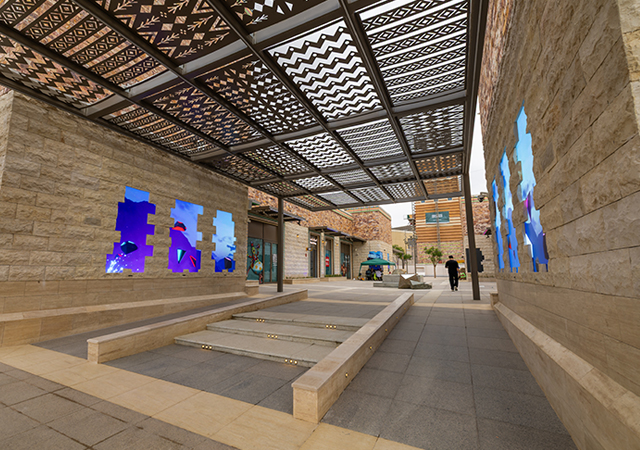
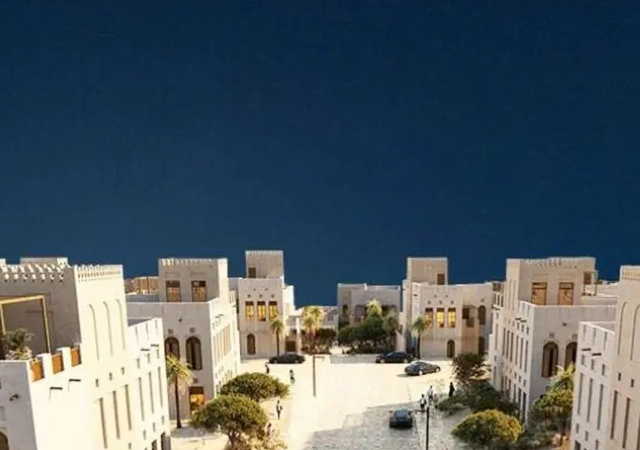
SEVEN Abha’s architectural language takes inspiration from Aseer’s stone-built heritage.
In Abha, that can be seen clearly in the architectural language of the destination, which takes inspiration from Aseer’s stone-built heritage. At the same time, the fully indoor format creates a comfortable, year-round environment in which entertainment, dining and retail can come together under one roof.
That principle extends across the portfolio. We combine internationally recognised partnerships with homegrown Saudi concepts and tailor the overall experience to the characteristics and needs of each market. The objective is consistency in quality, but individuality in experience.
What engineering or construction innovations were essential to deliver next-generation indoor entertainment complexes in diverse climates like Abha, Tabuk, and Riyadh?
The complexity of SEVEN’s portfolio comes from bringing very different entertainment typologies together within integrated destinations, often involving sophisticated ride systems, immersive technology, digital infrastructure, food and beverage, retail and highly specialised operational requirements.
Our approach has, therefore, been to consider design, construction and eventual operations as an integrated process. Rigorous testing and commissioning are critical. Across our attractions, we apply five lines of inspection beginning at design certification, continuing through manufacturing, installation, testing and commissioning, and ultimately supporting ongoing inspection and maintenance once the attraction is operational.
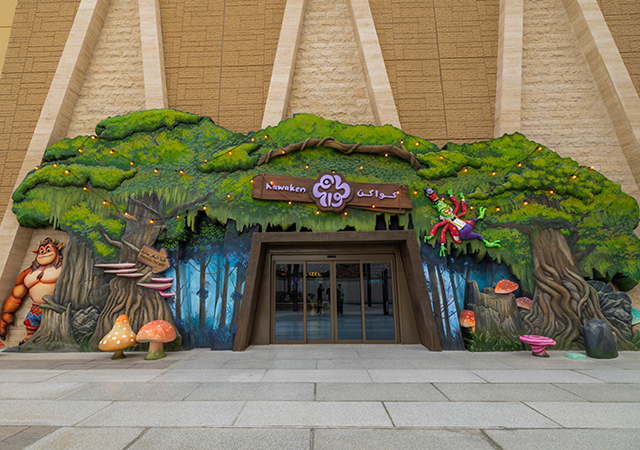
SEVEN has created Kawaken and other homegrown concepts as in-house entertainment brands for its leisure destinations.
We have also embedded efficiency and sustainability into the engineering approach, including energy-efficient systems, water-management measures and rigorous commissioning of key building systems. This allows us to deliver destinations that are not only technically sophisticated but designed for reliable, efficient long-term operation.
SUPPLY CHAIN AND LOGISTICS AT SCALE
Given the worldwide procurement of specialised rides and thematic materials, how did SEVEN successfully manage international shipping and local site delivery without major delays?
Delivering specialised entertainment assets at this scale requires close coordination across design, procurement, manufacturing, logistics, installation and commissioning. Many of the systems within our destinations are highly specialised, so their delivery cannot be treated in isolation from the wider construction programme.
A key part of our approach has been early planning and close collaboration with our partners throughout the delivery cycle. We work with both global entertainment leaders and local partners, creating a supply chain that combines international expertise with strong on-the-ground capabilities in Saudi Arabia.
Just as importantly, the process does not end when an asset arrives on site. Our quality framework extends from design and manufacturing through installation, testing and commissioning, which allows potential issues to be identified and managed before they affect operational readiness.
With tens of thousands of workers active across your sites, how did SEVEN maintain its impressive safety record down the home stretch of these Wave 1 completions?
Safety is embedded into every stage of SEVEN’s delivery model and is treated as a shared responsibility across our teams, contractors and partners.
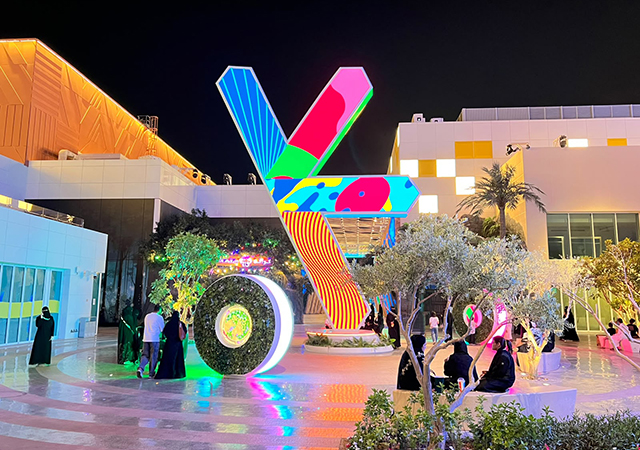
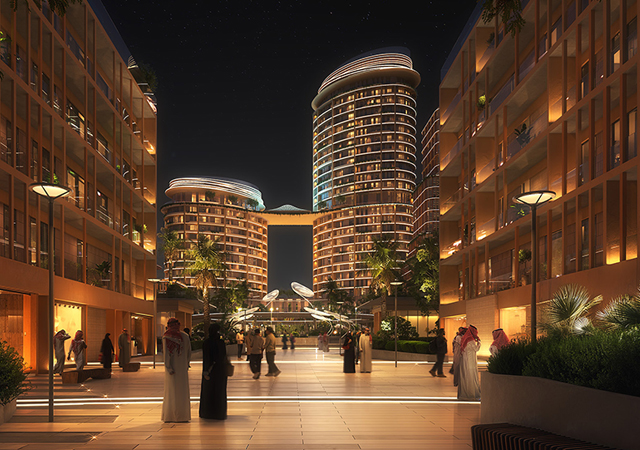
The Tabuk destination was the second of SEVEN’s entertainment hubs to open in Saudi Arabia.
Our Health & Safety Management System is aligned with internationally recognised standards, including ISO 45001, alongside full compliance with Saudi regulatory requirements. We apply rigorous contractor prequalification, permit-to-work systems, inspections, audits and ongoing performance monitoring across our projects.
However, systems alone do not create a strong safety culture. We place significant emphasis on leadership engagement, workforce competency, continuous training and behavioural safety. The objective is to create an environment where everyone involved in delivering our destinations understands that safety is integral to performance, rather than a separate requirement.
With 14 destinations under construction simultaneously, how is SEVEN maintaining rigorous standards for quality, cost, and schedule across the portfolio?
Managing a portfolio of this scale requires consistent governance, project controls and performance oversight, while allowing individual project teams to respond to the requirements of each destination. This provides consistent visibility across schedule, cost, risk and delivery performance, enabling emerging issues and variances to be identified early and addressed at the appropriate level.
We apply defined quality-control indicators throughout the project lifecycle, supported by rigorous handover, testing and commissioning processes. Attraction safety specifically is covered by our five-line inspection framework.
The portfolio model also enables us to transfer lessons between projects. As destinations progress through different stages of delivery, knowledge from one site can inform another, helping teams identify risks earlier, improve processes and maintain consistency.
Ultimately, the measure of successful delivery is not simply completing construction. A destination must be safe, operationally ready and capable of delivering the quality of guest experience we have committed to.
What lessons learned from managing one of the kingdom’s most ambitious construction portfolios are now being institutionalised across Wave 1 and beyond?
One of the most important lessons is the value of treating every project as part of a wider portfolio rather than as a standalone development.
When teams, consultants, contractors and operators transfer knowledge from one destination to the next, the entire programme becomes stronger. Lessons around design coordination, constructability, testing, commissioning and operational readiness can be incorporated earlier into subsequent projects.
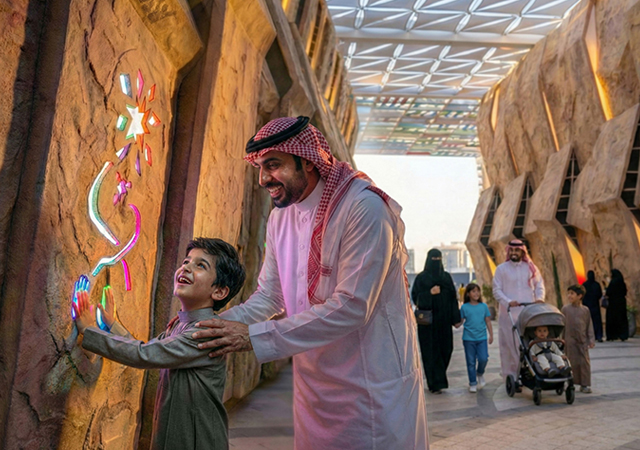
SEVEN Tabuk offers family-oriented experiences.
Another key lesson has been the importance of integrating operational thinking into the delivery process from an early stage. Building an entertainment destination is only one part of the challenge; it must ultimately operate safely, efficiently and consistently while delivering a seamless guest experience.
This continuous-learning approach is now being institutionalised across SEVEN as the portfolio progresses. Each destination generates insights that help strengthen future projects and enhance delivery, operational readiness and guest experience.
You previously engaged contractors across multiple project sites to ensure knowledge continuity. How effectively has this multi-site contracting strategy paid off during construction?
Continuity has been valuable because it enables knowledge developed on one project to be retained and applied elsewhere in the wider portfolio.
Entertainment destinations are technically complex assets, and there is a learning curve associated with integrating specialised attractions, building systems, theming and operational requirements. Working with partners who understand SEVEN’s standards and delivery expectations helps reduce that learning curve as we progress across multiple sites. At the same time, our focus remains on maintaining rigorous standards across every project. Repeat collaboration creates value by strengthening coordination, deepening familiarity with our quality and safety requirements, and improving delivery efficiency.
COMMISSIONING CHALLENGES AND SOLUTIONS
What were the top three construction or commissioning challenges on the Abha site, and what solutions ensured on-time delivery?
The first was ensuring that a technically complex, fully indoor entertainment destination could deliver international standards while remaining genuinely connected to Aseer. That required close coordination between architecture, engineering, attractions, theming throughout the delivery process.
The second was managing the interface between conventional construction and specialised entertainment systems. Attractions require their own manufacturing, installation, testing and certification processes, so those activities need to be carefully integrated into the wider construction and commissioning programme.
The third was moving from construction completion to genuine operational readiness. Our approach uses multiple layers of inspection and testing, including independent certification where required, to ensure attractions and key systems are operating as intended before they are handed over.
These challenges reinforced the importance of integrated planning, early coordination and rigorous commissioning. For us, completion is not simply when construction ends; it is when the destination is ready to operate safely and deliver the experience our guests expect.
How is SEVEN supporting Aseer’s broader tourism and hospitality ecosystem (transport, events, hotels nearby)?
SEVEN’s core role is to develop and operate entertainment destinations, but these destinations are designed to contribute to a much wider economic and tourism ecosystem.
In Aseer, SEVEN Abha adds a major year-round leisure proposition to a region that already has a distinctive tourism identity. By creating another reason for residents and visitors to spend time in Abha, the destination can support activity across hospitality, food and beverage, retail, transport and other local businesses.
We are also committed to ensuring that the economic impact extends beyond the destination itself. SEVEN works with local businesses and entrepreneurs and prioritises local talent development, helping create opportunities across operations, hospitality, retail, dining and entertainment.
The broader objective is complementary: SEVEN Abha should strengthen the region’s existing tourism proposition and contribute to Aseer’s development as a year-round destination.
Looking ahead to your goal of opening at least three to five destinations per year through 2028, which cities or projects are currently lined up for Wave 2?
Our immediate priority is the disciplined rollout of the destinations already progressing across the kingdom and ensuring that each one opens at the standard our guests and communities expect.
SEVEN’s broader programme spans 14 destinations across 13 cities, creating a national entertainment network rather than concentrating world-class experiences in only one or two major urban centres.
Our rollout will continue in line with the approved programme, while maintaining a disciplined focus on operational readiness, safety and guest experience for every destination. Opening dates and destination details will be announced as each project reaches the required level of readiness.
What will remain consistent is the principle behind the programme: bringing distinctive, high-quality entertainment closer to people across Saudi Arabia while creating opportunities for local talent, businesses and communities and contributing to the ambitions of Vision 2030.