








































































In an industry long dependent on chemical adhesives that quietly release harmful emissions into homes, offices and public buildings, an Indian company is introducing a new alternative that promises to change what holds modern wood products together, writes SREE BHAT.
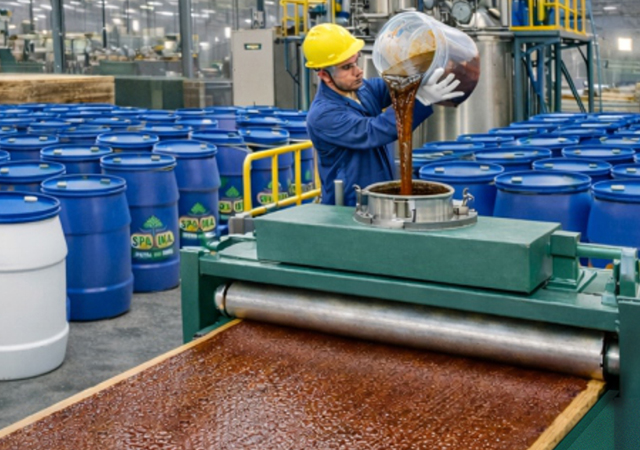
Varnika Srushti Enterprises has launched Spatika Bio-Resin, a bio-based adhesive that the company describes as the world’s first urea- and formaldehyde-free resin developed specifically for the plywood and wood panel sector.
For a market increasingly shaped by environmental regulations, healthier indoor spaces and pressure for cleaner manufacturing, the launch reflects a broader shift in how industrial materials are being rethought – not only for performance, but for their long-term impact on human health and sustainability.
The company says the product is the result of years of dedicated research into developing an adhesive that eliminates one of the wood industry’s most persistent concerns: formaldehyde emissions.
Why formaldehyde matters
For decades, formaldehyde-based resins have been widely used in plywood, particleboard, medium-density fibreboard and laminates. However, they also come with well-documented concerns.
Formaldehyde emissions from furniture, panels and interior materials can affect indoor air quality (IAQ) and have been linked to respiratory irritation, allergic reactions and long-term health risks, especially in enclosed spaces.
As building standards tighten globally and consumers become more aware of indoor environmental quality, manufacturers are under increasing pressure to adopt alternatives that reduce chemical exposure without compromising strength or durability.
According to Varnika Srushti Enterprises Managing Partner Niranjan S, the new adhesive is designed as a 100 per cent formaldehyde-free, non-toxic and E-0 grade resin, offering manufacturers a safer substitute for traditional chemical bonding systems.

Spatika Bio-Resin ... described as the world’s first urea- and formaldehyde-free resin.
Performance without compromise
The company insists that sustainability does not come at the expense of industrial performance. Spatika Bio-Resin has been developed to deliver strong bonding strength required in commercial wood manufacturing while fitting into existing production systems. That means plywood and panel manufacturers do not need to invest in new machinery or alter current production lines to adopt the material.
The resin is also designed with a longer shelf life, which the company says helps reduce storage losses and lowers overhead costs over time. Available in both liquid and powder forms, it offers flexibility across different manufacturing processes and production requirements.
Cleaner manufacturing, healthier interiors
One of the strongest selling points of the resin is its contribution to cleaner production environments. By removing formaldehyde from the adhesive stage, the company says manufacturing facilities can significantly reduce chemical exposure for workers while also lowering emissions during production.
The benefits continue after manufacturing. Wood products made using conventional adhesives can release residual chemicals for years after installation. In homes, schools, hospitals and office buildings, that can directly affect indoor air quality.
Spatika Bio-Resin is positioned as a material that supports healthier interior environments by eliminating that risk at source.
For architects, interior designers and furniture manufacturers working in projects where air quality standards are increasingly important, such materials are becoming more relevant than ever.
Another advantage highlighted by the company is improved fire resistance in treated wood and composite products.
A broad range of applications
Although developed primarily for the plywood and wood panel sector, the resin’s application extends far beyond one segment.
The company says it can be used in plywood manufacturing, particleboard production, medium-density fibreboard (MDF), hardboard, laminates, furniture, cabinetry and flooring.
The resin’s customisable properties also allow it to move into other sectors. Potential applications include: Paper industry, textile processing, natural fibre industries such as jute and coir, moulded components, electrical fittings, insulating materials, household appliance parts and selected automotive applications, says Niranjan.
Sustainability linked to agriculture
The company says Spatika Bio-Resin is made using sustainable and biodegradable raw materials, reducing dependence on petrochemical inputs. It also sees potential economic benefits beyond manufacturing by creating demand for agricultural raw materials and supporting rural supply chains. That gives the product a dual sustainability narrative: cleaner industrial output and wider economic participation through natural sourcing.
Built from long-term research
Based in Bengaluru, Varnika Srushti Enterprises says its expertise spans more than two decades across bio-based resins, wood panels, fire-rated doors and eco-friendly industrial products.
Research and development remain central to the company’s strategy, particularly in creating materials that combine commercial practicality with environmental responsibility.
Alongside bio-resins, its product portfolio includes sustainable wood panels, fire-rated doors and natural agricultural inputs.
The company is now seeking market representation in the Gulf countries, where green construction standards are gaining momentum, adds Niranjan.