












As inspirational works of architecture continue to take form in Dubai, it is perhaps only befitting that one of the city's newest shopping malls - the Mercato Town Centre - draws on a theme from a period in history known as the golden age of creativity and culture: the Renaissance.
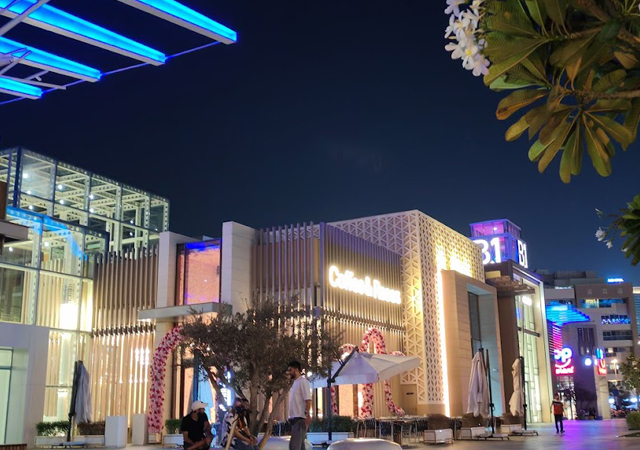
The latest shopper's paradise, which is said to be the Gulf's first full-themed mall, boasts visually stunning interior and exteriors, inspired by the timeless beauty of the Renaissance.
And it is perhaps no coincidence that its developer, the Al Zarooni Group, chose a top Italian architect, Daniele Morelli, to give shape to the vision of Abdulrahim Zarooni, a seasoned entrepreneur with an eye for artistic excellence.
Morelli's relationship with Dubai dates back to the mid-70s and he has known Zarooni since then and he was thus the first choice when the idea of a Renaissance-style shopping mall in Dubai germinated in Zarooni's mind.
Why the Renaissance? Morelli explains: 'It means 'rebirth' and was the period immediately following the Middle Ages in Europe. It was characterised by a surge of interest in classical learning and values. Spanning from 14th to 16th centuries, this period witnessed the discovery of new continents, great strides in astronomy, decline of the feudal system, growth of commerce, and potentially powerful innovations like paper, printing machine, the mariner's compass, and much more. A period so rich in human achievement will always excite and inspire people.
In the Mercato's colourful design, Morelli's passion for the Renaissance distinctly shows through; yet he believes in 'recreating or interpreting a dream' rather than trying to imitate a 'real structure'. Mercato's architecture is a surreal blend of several styles, harmonising elements from various artists, several centuries and cities, primarily Florence, Venice and Pisa.
'The architecture of each city has its own nuances using the natural resources available in the vicinity and evolving in synergy with the topography of the place,' says Morelli. In designing Mercato, he has created a beautiful canvas that combines glimpses of all these remarkably rich cultural heritages.
The prestigious Dh300 million ($82 million) shopping destination recently opened its doors to the public on the Jumeirah Beach Road, next to Town Centre, which is also owned by the group.
Reminiscent of a Mediterranean market place, Mercato (Italian for market) has an overall developed area of 663,000 sq ft. The total leasable area of the mall is around 247,000 sq ft.
Based on a distinctive architectural concept, Mercato predominantly captures Italian flavour and artistic characteristics, says Abdulrahim Al Zarooni, chairman, Al Zarooni Group of Companies.
Describing the facility, Helmi S Al Adham, deputy managing director with Transemirates Contracting, main contractor on the project, says: 'The project comprises a basement, ground plus one-storey building. The development is unique as it is both externally and internally divided into different sections or buildings, with no two sections being similar.
'For example, one section follows the Roman style, another the Gothic style of architecture, one looks like a railway station and another resembles a tower. Different materials, colours and lighting have been used to emphasise each style.'
The main entrance to the mall from Jumeirah Beach Road is through giant double doors leading to a huge main square above which is a large skylight. This imposing feature capitalises on natural daylight and is designed to mirror the elegant style of a Milan railway station. The atrium area also features escalators leading to the first level.
'The design concept of Mercato is based on the Renaissance period, a golden age in history that witnessed the flourishing of arts and sciences,' says Zarooni.
'This project is a recreation not an imitation. The architecture of Mercato is a surreal blend of several styles, harmonising elements from various artists, several centuries and cities, primarily Florence, Venice and Pisa in Italy. The central open area in the mall replicates the concept of a 'square', the focal point of any Mediterranean town. The architecture, shop facades and furnishings all reflect this concept. Imaginative streets complete with flower-filled window boxes, accentuate the continental theme, ' he says.
'Other features include medieval-style columns and arches, paintings and sculptures, giant frescoes adorning the walls and discreet lighting enhancing the mystique.
'The decor has been painstakingly constructed by Decorpoint with the help of 160 artists - all recruited from abroad for the project - specialising in different techniques and decoration styles.'
Besides the architecture, the lighting is also one of the striking features of this mall.
The flooring comprises special tiles which are highly resistant to stains and traffic.
All the materials and fittings used throughout the mall have been designed to create the impression of a medieval building.
'A lot of research has gone into planning and executing the concept. Prior to construction, the advice of international retail consultants was sought and a feasibility study was carried out. As a result, the mall is like a piece of art and not a lifeless construction project,' says Zarooni.
Spread over two levels, the mall features 13 fashion shops, four home decor and furniture outlets, four cafes and restaurants. In addition, it has a food court featuring nine outlets located on the first level. The mall also has seven cinema screens on level one - the first to come up in the Jumeirah area.
The ground floor has the largest store in the Spinneys' portfolio, which is spread over a 40,000 sq ft area. Excluding the Spinneys supermarket, fashionwear represents 50 per cent of the space taken up. The first Virgin bookstore in the Middle East is also based here.
The development also offers 700 underground parking spaces in the basement and another 300 around the complex. The building has three entrances while there are a further four entrances and exits to the basement.
A high level of security at the mall is ensured by a close-circuit television (CCTV) which is monitored round-the-clock.
Safety features include an addressable fire alarm system; sprinkler and fire-fighting systems; emergency lighting system and a central smoke extract system.
There is also gas supply to restaurants. MEP services include a heating, ventilation and air-conditioning (HVAC) system using water-based chillers, a building management system (BMS), drainage services, water services in line with the latest Dubai Municipality requirements, electrical services, automatic car and people counting systems, central battery system, lightning protection system and a standby generator set.
Transemirates started work on the project in July 2000 and completed it in September last year. The building sits on a raft foundation comprising piles and rafts. The superstructure comprises precast elements.
'The project was challenging as it's not a typical building. Both externally and internally, the building is divided into sections and no two sections are similar so there was no standard mould, ' says Mustafa Al Jallad, project manager with Transemirates Contracting
Another major difficult aspect of the project was dewatering. 'There was no stormwater drainage so we had to drill under the road to lay dewatering pipes to take the water flow to the sea,' he explains.
Dubai-based Transemirates Contracting, a member of Al Zarooni Group of Companies, is one of the leading construction companies in the UAE. Over the past two decades, the company has established a reputation as of the Gulf's most dynamic and forward thinking construction firms.
At TransEmirates Contracting quality is more than just a watchword, it's a way of life. And it is one of the reasons why we have been involved in constructing some of the UAE's most outstanding landmarks, says Helmi
'We pride ourselves on our ability to deliver clients a complete construction package, from pre-planning to hand over - in effect we are the one-stop shop for any project.
Some of its prestigious projects include Dubai Electricity and Water Authority headquarters complex building, Al Attar Tower on Sheikh Zayed Road, Microsoft, IBM and Cannon Building in Dubai Internet City, National Bank of Umm Al Quwain building, Warba Centre (all in Dubai) and Crystal Plaza in Sharjah.
The company has a branch office in Al Ain and has undertaken projects in Abu Dhabi, Al Ain and Sharjah, although Dubai is its main market.


