







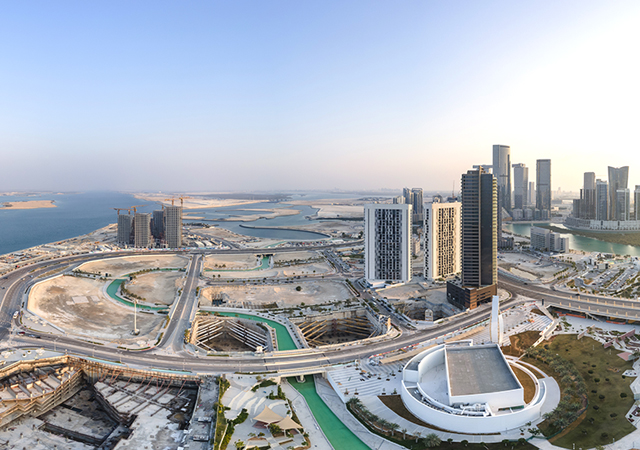


































Work has begun on the long-awaited Third Crossing to connect Abu Dhabi island to the mainland at the northern end of the Maqta Channel.
With figures released by Abu Dhabi's Traffic Licensing Department, indicating an 84 per cent increase in the number of vehicles on the roads of the UAE capital over the past five years, and the significant increase in inter-Emirates road travel, a third bridge crossing over the Maqta Channel to Abu Dhabi is long overdue.
Traffic, particularly during the 'rush hours' is often at a virtual standstill 'on and off' the island.
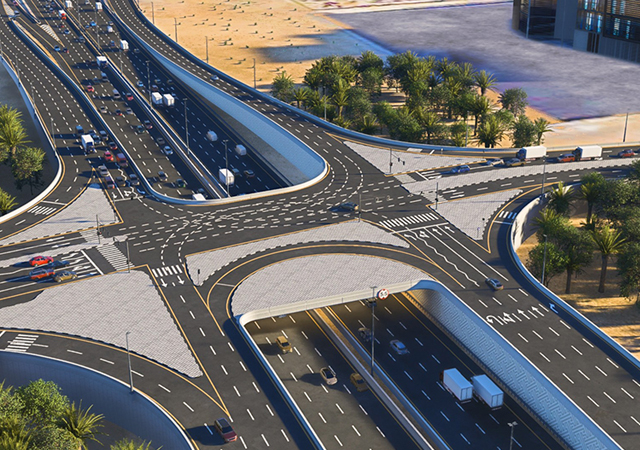
The new 850 m long crossing will link with the inter-Emirates highway, allowing traffic bound for Al Ain and Oman to use the older Maqta bridge. This, in turn, allows the remaining traffic flow to the large industrial complex of Mussafah to use the Mussafah bridge.
The new four lane, dual carriageway bridge project is a hybrid structure design, comprising central asymmetric arch ribs supporting prestressed concrete box girder decks.
The international construction group Archirodon Construction has been awarded the contract for phase 3 construction of the bridge by the Abu Dhabi Public Works Department.
Currently, Hilal Bil Badi, main contractor under phase 2 of the project , is focusing on earthmoving elements of the road, including some 3 km of new link roads and ramps, together with almost 2 million cu m of embankments 'back fill' on both sides of the channel and extending more than 1 km to support the central span.
Here, Hilal Bil Badi is successfully nearing completion on the northern embankment to a height of 16 m across a width of 100 m and a length of almost 650 m.
Meanwhile, on the southern embankment, 9 m has been compacted of the final 15 m height.
Material for the embankment is supplied from the Sweihan district. Laid in 35 to 36 cm layers, the contractor is relying on a fleet of compaction rollers, including three Dynapac units, to compact the layers to a 30 cm thickness.
The Dynapacs include a recently delivered CA250D single drum roller ordered through local distributor Inma, plus a CC222C and a CC422C.
According to a spokesman for Hilal Bil Badi, the Dynapac rollers generally make a minimum of seven passes to achieve the required 95 per cent compaction density; with varying pass lengths of between 40 and 120 m.
The Dynapac CA250D has been designed to compact up to 550 sq m/h and features a drum width of 2,130 mm, providing a maximum operating weight of 13,650 kg.
All the Dynapac rollers are used in a variety of applications across the project and also moved to other projects in Abu Dhabi, as required.
The contractor is also relying on a number of Dynapac pneumatic-tyred rollers, particularly for finishing soil compaction duties on the new link roads.
On the largest stretch, almost 750 m long from the northern embankment to the main interchange on the access road to the city at Al Garm Street, a Dynapac pneumatic-tyred roller has ensured a smooth surface across the dual four-lane carriageways.
In total, 1.05 m of sub-base, base and rock aggregate layers have been prepared ready for asphalt laying, to ensure a total final thickness of 1.31 m.
Work is also well advanced on the supporting columns along the route particularly close to the main embankments.
On the northern end, for example, 11m high walls are nearing completion. Featuring a thickness of 2.1 m, the walls are constructed on top of two 12 m by 22 m by 3.5 m pile caps and a total of 36 piles of 1 m diameter and 23 m depth.
Roads upgrade
Abu Dhabi Municipality has also announced plans to reduce the city's traffic jams by upgrading many of its three-lane roads into four lanes.
Work has started on one of the first, the city's Fourth Road, with Hilal Bil Badi awarded the contract covering more than 9 km.
Once again, the contractor has 'teamed up' with its Dynapac fleet for compaction duties.
On the first section of the 9 km award, the contractor is completing four base layers totalling 28 cm over a distance of 1.5 km in both carriageways. These comprise two 6 cm layers and two 8 cm layers with the latter made up of asphalt base material.
Generally working in tandem, the contractor is using a Dynapac CA222D single-drum roller and a Dynapac CP271 pneumatic-tyred roller to ensure an even smoother finish.
Two final 5 cm wearing courses will complete the fourth lane.
Other measures to improve traffic flow and reduce the daily congestion in the city include the construction of additional 'flyovers' and the installation of advanced traffic control systems.