



































































saudi Arabia’s giga-projects, the GCC’s rapidly expanding data centre market and the region’s ambitious sustainability agenda are driving one of the world’s largest construction booms. Yet delivering increasingly complex projects on time and within budget is becoming ever more challenging.
From extreme heat and water scarcity that complicate data centre cooling to supply chain disruptions, skills shortages, rising costs and fragmented project controls, contractors face mounting pressure to make faster, better-informed decisions. With many mega-projects still relying on disconnected data and manual reporting, delays and cost overruns remain commonplace – highlighting the growing need for AI-powered, real-time project intelligence
Indeed, reports suggest that in 2025, major infrastructure and mega-projects averaged 83 per cent over their initially scheduled timelines. Furthermore, disputes were costing upwards of $154 million per project on average.
Despite AI being perfectly positioned to deliver real value in the GCC construction sector, uptake remains low, suggesting many companies are still using fragmented project controls systems.
With essential data often outdated by the time it reaches decision-makers, meaning it is too late to correct the course of action, this perhaps may go some way towards explaining why infrastructure and mega-projects across the Gulf are witnessing substantial delays.

Rennick: “Having access to schedule intelligence that’s grounded in truth, fully verifiable and immediately available could be the solution the GCC needs”
Research by McKinsey & Company also revealed a lack of connected data was cited by Gulf construction professionals as one of the primary reasons behind the current bottleneck.
This is hardly surprising, given traditional project controls systems often lack the real-time integration required for modern projects operating in changeable and highly volatile environments. Furthermore, manual systems such as these are often too slow and inflexible to manage such complexity, especially with project-critical data locked in static spreadsheets and fragmented documents.
Therefore, with such complex projects requiring trusted, data-driven conclusions, such as risk and mitigation, acceleration decisions and change management, the effectiveness of an auditable intelligence layer on project schedules that drives more informed decision-making speaks for itself.
This is where a connected intelligence loop can play a critical role.
Fully integrated project controls
Manual project control processes can complicate the standardisation of data and the maintenance of schedule integrity, ultimately risking misinformed decision-making and delays. Furthermore, they can miss critical intelligence that could otherwise surface acceleration opportunities and delay threats while there’s still time to act.
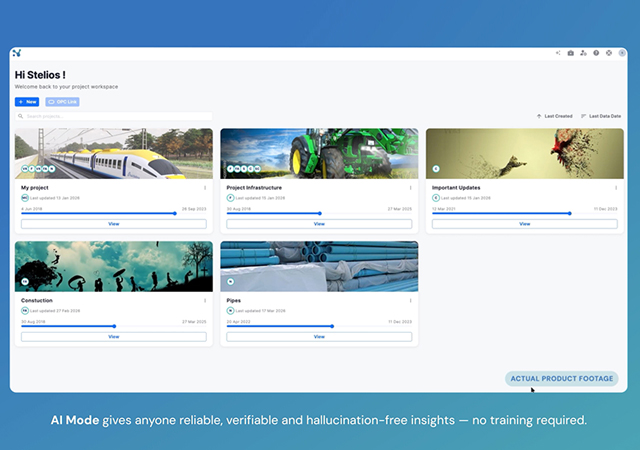
Conversely, Field-to-Board AI is able to update live schedules with AI-captured progress and run instant schedule analysis and risk intelligence to drive decision-making and inform on-site actions.
Fully autonomous, this innovative system works in three connective steps, moving from the physical site to the single source of truth for the schedule and then, finally – and most crucially – the analysis layer.
AI-powered spatial intelligence and the use of off-the-shelf 360-degree cameras automatically capture site progress and compare the as-built conditions to BIM. Work is then tracked by area, BIM category and trade, with validated, objective progress data then fed directly into the Cloud. Critically, this eradicates the need for site walks and subjective self-reporting to verify what should already be known.
As the single source of truth for the schedule and the live system of record, this is then continually updated with field reality, rather than needing to wait for manual inputs.
Operating as the system of intelligence, the final phase of the connected loop runs autonomous schedule analysis, risk assessments, integrity checks and forecasts across every logic tie, every constraint and every activity every time the schedule updates. As a result, project controls teams are provided with up-to-date, auditable decision intelligence in seconds.
Through the use of Field-to-Board AI, contractors, schedulers and project management officers are given a real-time understanding of the project’s progress and the accuracy of the current schedule.
Ultimately, it means no more waiting for a monthly update to understand the status of the project and a transition away from periodic progress towards continuous visibility.
More trusted and faster schedule updates
Instead of information being provided through contractor self-reporting, a connected intelligence loop enables spatial evidence to be clearly and accurately demonstrated. Consequently, project controls teams, planners and schedulers working on mega-projects and critical data centre constructions are given faster, more trusted and more verifiable schedule updates.
By detecting hidden bottlenecks, such as supply chain delays or scheduling conflicts, those leveraging auditable decision intelligence can surface emerging risks before they become delivery problems.
Furthermore, unlike when traditional project controls methods are used, risks aren’t just rescheduled after the fact for claims purposes.
Providing critical intelligence people can actually act on, auditable decision intelligence systems empower project teams, schedulers and every stakeholder to focus on analysis and mitigation, as opposed to data collection.
While AI is increasingly becoming a vital proponent of scheduling and project controls, critical analysis will always require human judgement.
Driving productivity
While data centres can often be space-intensive and major consumers of energy, the typical geography of Gulf cities offers a superb opportunity for substantial construction – with power costs low and space plentiful.
As a result, data centre demand across the GCC is expected to significantly intensify in the coming years. Indeed, the data centre market is projected to reach $9.49 billion by 2030.
With this in mind, ensuring projects remain on schedule and on budget is imperative. By leveraging trusted, industry-accepted project controls methodology, project delivery shifts from a reactive, administrative-heavy process to a more data-driven, proactive method.
Having such a holistic view of the entire project, including complete oversight on any potential risks and delays or scheduling conflicts, means project controls teams and planners are provided with the most reliable and verifiable information that’s gathered through direct observation rather than estimation.
Crucially, having all vital information and data collected, validated and updated automatically means construction schedulers across the Gulf have more time to analyse the insights, assess any risks and generate critical insights to drive data-driven and more informed decision-making.
In an industry, and a region, where the consequences of a poorly-made or missed decision are measured in hundreds of millions of dollars and potentially months of delays, having access to schedule intelligence that’s grounded in truth, fully verifiable and immediately available could be the solution the GCC vitally needs to transform its data centre landscape and take advantage of the likely surge in demand in the coming months and years.
* Stephen Rennick is Head of Commercial EMEA at Nodes & Links, a decision intelligence platform purpose-built for capital project delivery.