

































Confidence in the global construction sector has fallen sharply over the past year, as organisations battle escalating cost pressures, supply chain disruption and persistent geopolitical instability, according to new global research from Currie & Brown, a world-leading provider of cost management, project management and advisory services.
The firm’s annual Construction Certainty Index surveyed more than 1,300 construction and infrastructure decision-makers across the Americas, Europe and Asia-Pacific.
The research found that uncertainty has added on average 12.4 per cent to respondents’ construction pipeline costs over the past 12 months. Applied to forecast global construction spending, this represents almost $2 trillion in 2026 – close to the annual economic output of Brazil.
Fewer than half of organisations (46 per cent) are confident that they can meet project deadlines, and 40 per cent are confident that they can stay within budget – a drop of 12 and 14 percentage points respectively from last year.
What’s putting delivery confidence under pressure
This decline in confidence reflects the mounting pressures facing project teams. According to the research, confidence has fallen across every measure tracked, with the sharpest declines in the two areas that matter most to project viability – time and budget.
Seven in 10 (70 per cent) respondents identified material cost inflation as having a high impact on project delivery, 64 per cent identified energy price volatility and 59 per cent supply chain disruption. Economic policy change (56 per cent) and labour and skills shortages (54 per cent) are also significant factors. These risks are closely connected and can amplify one another, increasing the overall pressure on project costs and delivery. Concerningly, organisations expect most of these risks to worsen over the next 12 to 24 months – with 65 per cent expecting material cost inflation to intensify further, and 58 per cent expecting the same of energy price volatility.
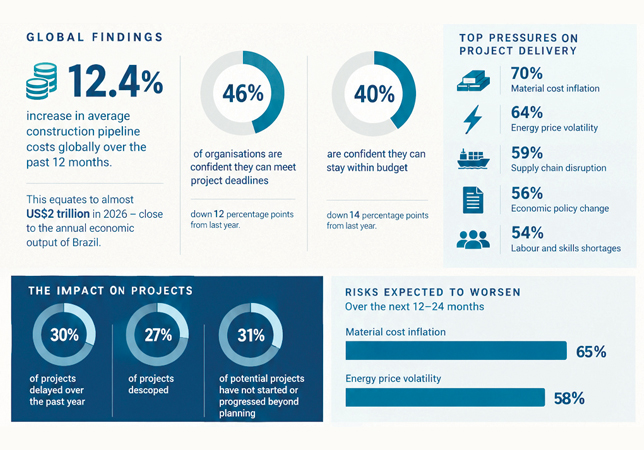
The consequences are already being felt across project delivery. On average, respondents report that 30 per cent of projects have been delayed over the past year and 27 per cent have been descoped. On average, 31 per cent of potential projects have not started, or progressed beyond planning as a result of uncertainty.
In the Middle East, these pressures are being felt alongside continued investment and ambitious development programmes. Changing market conditions are influencing how projects are procured and delivered, but the sector is adapting. Clients are paying closer attention to current market conditions, contractor and supplier capacity, and how risk is managed across the project lifecycle.
As conditions change, decisions made earlier in a project may need to be revisited, making up-to-date market intelligence increasingly important to protecting cost and programme.
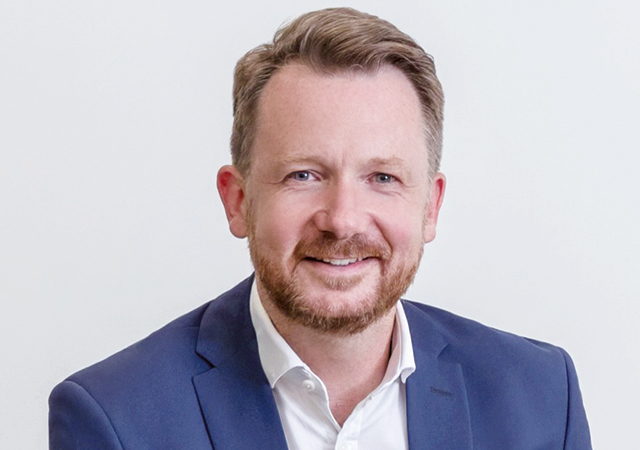
“The scale and ambition of development across the Middle East continues to create significant opportunities,” says Craig Finlayson, Regional Commercial Director, Middle East at Currie & Brown. “Geopolitical pressures, rising costs, competition for resources and supply chain disruption are making delivery decisions increasingly complex. But we’re seeing the industry, across the region, adapting rapidly.”
“Whether delivering the ambitions of Vision 2030 in Saudi Arabia or major programmes in the UAE, greater certainty comes from understanding risks early. We’re seeing clients take a more considered approach to decision-making. It’s important to establish realistic cost and programme expectations as early as possible. This allows project teams to tackle risks head on, while maintaining the flexibility and adaptability critical to successful delivery,” he adds.
A blueprint for certainty
Despite a challenging outlook, the research identifies a distinct group of organisations reporting consistently higher levels of delivery confidence and experiencing fewer severe impacts from uncertainty.
Representing around 32 per cent of respondents, these ‘higher maturity’ organisations continue to invest strategically through periods of uncertainty, building capability in the areas associated with stronger decision-making, including:
• Greater use of AI to identify, monitor or mitigate risk;
• Digital technologies to influence
project and asset decisions;
• Data analytics to mitigate uncertainty;
• Embedding sustainability into project delivery; and
• Investing consistently in skills and training.
The research finds that these higher-maturity organisations are considerably more confident that they will hit their targets, with 58 per cent feeling confident they will meet deadlines, and 47 per cent confident of staying within budget compared to 41 per cent and 36 per cent of the rest of the sample, respectively. Just 26 per cent report cancellations affecting 25 per cent or more of their pipeline, against 40 per cent for the rest of the sample – a difference of more than a third.
This gap is evidence that targeted capability building can improve resilience and better insulate organisations from sector shocks.
Dr Alan Manuel, Group Chief Executive Officer at Currie & Brown, said: “An extra $2 trillion of cost to build the world’s homes, hospitals and critical infrastructure adds up to projects that arrive late, break budget, are scaled back, or never get built at all.”
“Organisations can’t afford to lurch from one crisis to the next or simply wait for calmer conditions. Those that are resilient to uncertainty share common characteristics. They’re investing in the people, technology and data that enable them to gain an earlier, clearer view of where they are exposed – and the judgement and skills they need to take action. Embedding this approach is how certainty is built.”
The full 2026 Construction Certainty Index explores the drivers of uncertainty, its impact, and how organisations can better build resilience.