








































































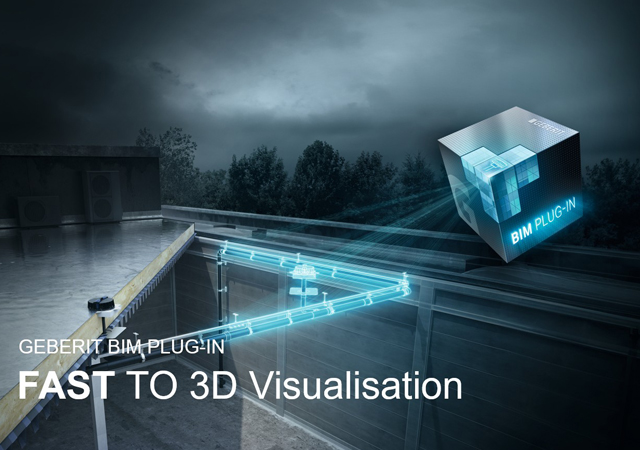
Swiss sanitary solutions specialist Geberit says its BIM Catalogue plug-in for Autodesk Revit has matured from a product-data library into a broader digital planning environment for sanitary installations since its 2019 launch. The latest maintenance release, issued in April 2026, extends this trajectory with refreshed catalogue content and new functions focused on Geberit Pluvia roof drainage design.
The current plug-in supports Autodesk Revit 2024, 2025 and 2026, giving engineering and planning offices access to market-specific BIM data linked directly to Geberit’s product information management system. This ensures that objects available for a project reflect tested and approved product information, the company says.
Parametric objects and catalogue scope
Geberit’s underlying approach remains unchanged: product data is provided through simplified parametric objects that carry the metadata required for planning while limiting the load on project files. The catalogue covers piping and installation systems as well as selected ceramic products and bathroom furniture, with associated product documents accessible from within the application.
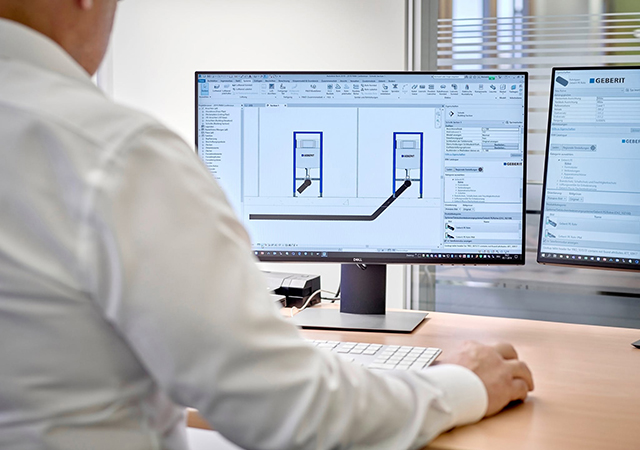
The Geberit BIM Catalogue plug-in for Autodesk Revit is available as a free download.
Core functions carried over from earlier versions continue to support detailed design, including division of pipework into specified lengths, component numbering and preparation of material lists. Bringing these operations together in one Revit-based application reduces the need to switch between separate planning tools, Geberit notes.
Recent content updates
Recent releases have expanded the available product content. The April 2025 update added BIM data for Geberit Silent-db20 SuperTube fittings and the new Geberit Duofix installation system, while the April 2026 catalogue update introduced Geberit CleanLine and CleanFloor30 assortments, together with traps for different washbasins and bidets.
The 2026 release places particular emphasis on Geberit Pluvia roof drainage projects. Fastening points that previously had to be positioned manually can now be generated and shown in the model after the system is calculated, in line with Geberit’s planning rules and project-specific parameters.
The Pluvia Assistant also determines fixed and sliding points and assigns expansion sockets and related components where required. These items appear in the BIM model, making it easier for designers to check how the calculated system translates into an installation.
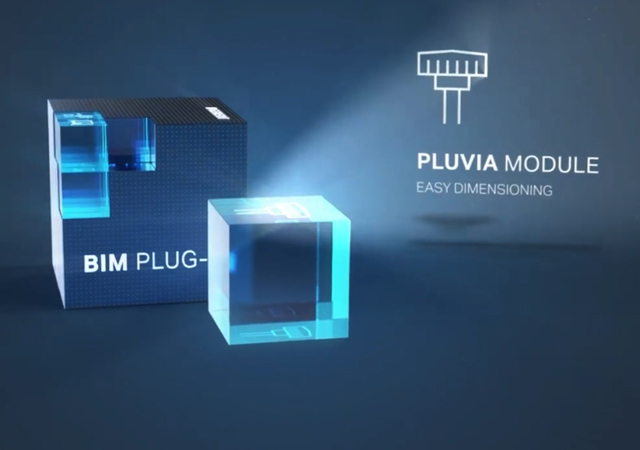
The latest plug-in update adds catalogue content and new planning functions for Geberit Pluvia systems.
For pipe runs installed at a greater distance from the ceiling, the software can now incorporate the Geberit Pluvia support set. Lateral support elements are positioned according to the relevant guidelines, displayed within the model and included in the material list.
A further function distributes brackets evenly along a selected pipe section. Geberit describes this as a relatively small change that addresses a repetitive stage of the planning process and gives material calculation a consistent basis.
Taken together, the updates illustrate how BIM tools for sanitary engineering are moving beyond static object libraries. The emphasis is increasingly on maintaining reliable product information and automating routine calculations, while leaving the designer in control of the overall system layout, the company says.
The globally operating Geberit Group is a European leader in the field of sanitary products and celebrated its 150th anniversary in 2024. Geberit operates with a strong local presence in most European countries, providing unique added value when it comes to sanitary technology and bathroom ceramics.
The production network encompasses 26 production facilities, of which four are located overseas. The group, headquartered in Rapperswil-Jona, Switzerland, has around 11,000 employees in more than 50 countries and generated net sales of CHF3.2 billion ($4.02 billion) in 2025.