














FROM iconic office towers to traditionally-designed residential buildings, KEO International, one of the Middle East’s best-known full service consultancy practices, has a number of projects in its portfolio which are set to make a design statement on Kuwait’s horizon.
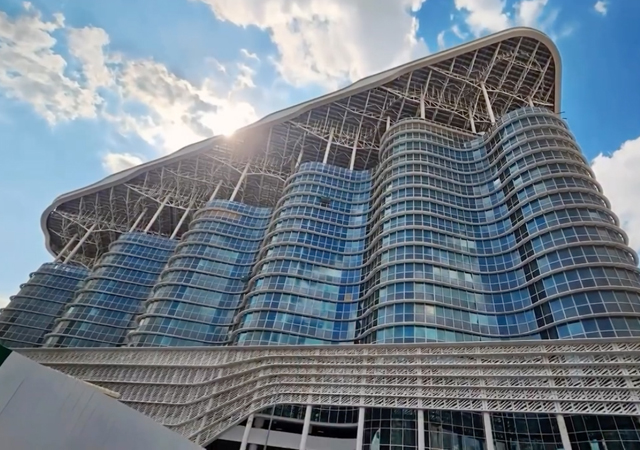
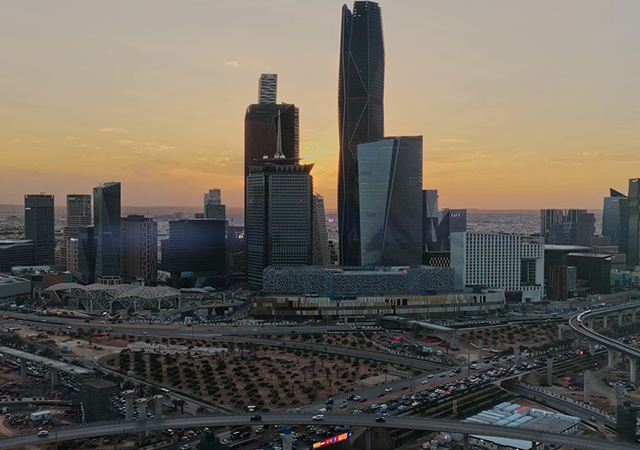
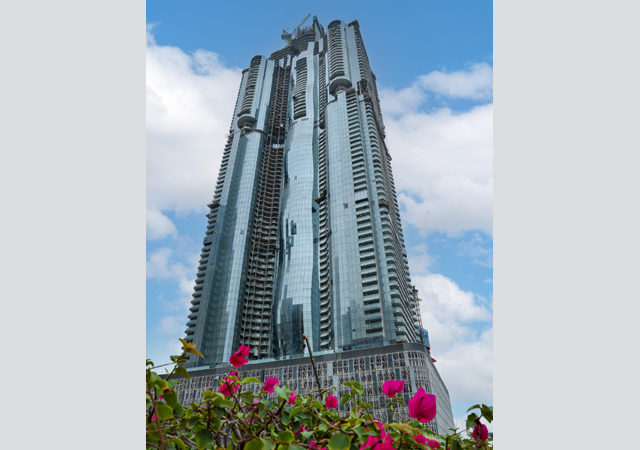
Perhaps the most striking one on the skyline right now is the Kuwait Trade Centre – the Al Tijaria Tower – which stands at its full height of 218 m.
Located in the Al Sharq region of Kuwait City, the tower dominates Al Sour Street, opposite Al Shahid Garden, with a land area of 4,295 sq m and grabs the attention because of its unique spiral glass form.
Commenting on the progress at the Kuwait Trade Centre, a spokesperson for KEO says: “The unique shape of Al Tijaria Tower is becoming ever more prominent as the curtain-wall installation progresses and the final touches to the interior are being given, while construction of the tower’s crown nears completion.”
Divided into 40 floors, the project consists of two basement floors, ground floors, a mezzanine floor and 37 typical tower floors surmounted by a huge crown. The tower is equipped with six panoramic elevators that allow the users to enjoy the view from a height.
The project is being developed by Commercial Real-Estate Company (Al Tijaria),
Describing the outstanding features of the tower, a spokesperson for Al Tijaria says: “The Kuwait Trade Centre has a distinguished architectural design and luxurious finishing, besides being equipped with the latest intelligent building systems. In addition, it has an attractive interior and exterior lighting design, making it one of the most luxurious and exquisite commercial towers in the region.”
The project includes a mall located on the four lower levels of the building as well as a health club on the first floor, overlooking the mall’s roof, which accommodates a swimming pool and planted spaces.
The retail podium of 7,420 sq m provides a range of services to tenants and visitors, including several entertainment activities and services such as a food court and coffee shops in all the podium floors.
Belajat Residential Tower
Smaller in scale yet stunning because of its architecture is the Belajat Residential Tower, another KEO-designed project which is close to completion with the interiors now receiving the finishing touches.
Located on a prime residential area in Salmiya, its 21 floors offer a built-up area of 11,000 sq m and accommodate 38 flats.
“This KEO design reflects the integration of traditional design heritage of Kuwait with contemporary technology. An impressive 26-m-high arch is the dominating feature of the façade,” says the spokesperson.
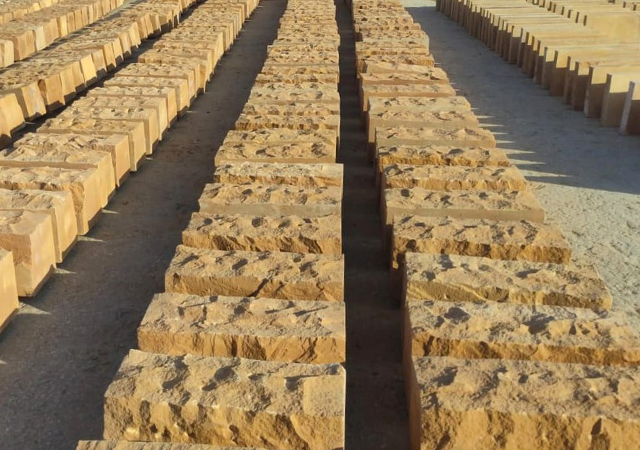
The entire facade is clad with varying textures of natural yellow stone and GRC. The stone cladding has been finished in a variety of ways, from highly polished, to hammered, flamed, unpolished and rough hand-cut, to achieve varying contrasts.
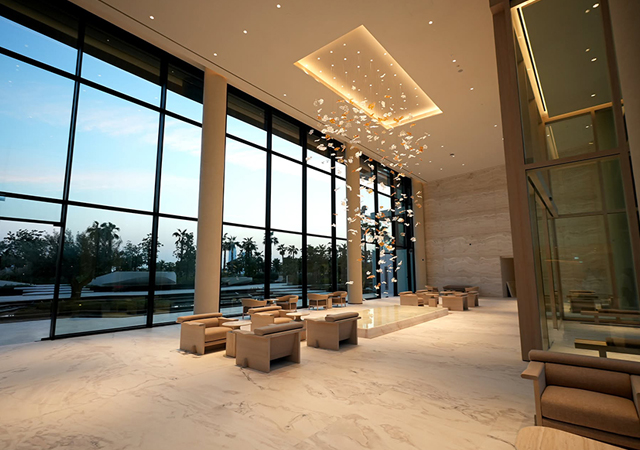
“Upon entering through the main arch, the visitor is greeted by a deeply carved vault overhead, which is adorned by a specially-manufactured chandelier from Italy, comprising thousands of crystal bead chains between 24-carat gold frames,” the spokesman explains.
From the second to the 16th floor are apartments which taper in size upwards with the reduction in floor plates. At the higher levels are the largest four bedroom apartments, with large terraces. At every level where the floor size reduces, grand terraces are formed. One main feature of each apartment is the availability of grand uninterrupted views of the sea, says the spokesperson.
“Also,” he points out, “by making almost each floor different from the floor above or below it, an exceptional massing is created, which makes the façade truly unique. Further creation of arcades and balconies heightens the interest in its overall mass.”
Despite its traditional look, the latest in electromechanical equipment has been chosen, designed and supervised by KEO, according to the spokesperson.
“The latest technology has been incorporated in the selection of fire prevention and detection systems, central television network, central high speed internet, communications and telephony, and the security and intercommunication systems. This has resulted in a unique building – a very traditional look, recalling the heritage of old, while embracing all the modern systems,” he says.
Kuwait Business Town
KEO is also involved in Kuwait Business Town, where it is responsible for work on two towers. Construction work has begun on Tower 5 of the project with the concrete for the second basement level being poured, while at Tower 6, excavation is still ongoing with work on the foundations expected to get under way soon.
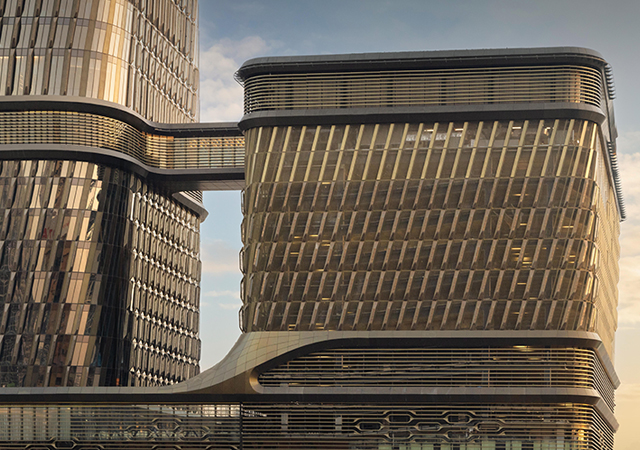
Standing at 40 storeys (184 m) and 36 storeys (168 m) respectively, the towers will make up one of three areas in the Kuwait Business Town development, which will provide office, hotel and retail space. KEO has provided the architectural design, landscape design, interior design and structural and MEP (mechanical, electrical and plumbing) engineering for the 40,000 sq m of office space commissioned by Kuwait Business Town Real Estate Company.
The towers are engineered to dynamically interact with each other as they move upward into the sky.
Raj Patel, KEO’s principal designer for the project, says: “The duelling interplay of these two tower is unique and unmatched in Kuwait. Each floor twists inward from the floor below as it moves up to create an ever-changing façade. The curtain-wall design combines the use of four elements – silver reflective glass, stainless steel panels, grey acrylic panels, and aluminum horizontal fins. The sun reflecting on these materials will create an ever-changing appearance of the façade during the day.”
The project, which has suffered planning delays, is now scheduled for completion in 2010. According to the KEO spokesperson, the delay had been due to a “permission issue as there were a few items that needed moving on the site”.
GUST
Construction work is now in progress on Phase Two of The Gulf University for Science and Technology (GUST) Kuwait, another landmark project by KEO. The 35,000 sq m campus occupies 100,000 sq m of the 150,000 sq m site in West Mishref, Kuwait. Phase One of the GUST Mishref Campus, which was completed in September 2006, caters to a capacity of 3,400 students and 200 staff members who represent 60 per cent of the ultimate population. Phase Two of the project is forecast to be completed by September 2010, and will boost the student enrolment capacity to 5,500 and 400 staff members.
The project’s design concept responds to the three distinct needs associated with any educational facility – the need to interact, the need to learn, and the need to gather, according to the KEO spokesperson. “These needs,” he says, “have been associated with objects and spaces which have traditional connotations in an attempt to position this modern facility meaningfully within the richness of the local culture.
He explains: “The suq, which is represented in the design as an enclosed, air-conditioned mall or concourse, is a place to interact.”
The concourse is at the centre of the concept and runs north-south and east-west providing student entrances at either end and a VIP entrance at its centre. It is characterised by its three-storey atrium lit from a skylight.
“This area provides the right environment to encourage students, staff and faculty to interact in order to achieve their full academic and professional potential. The wireless internet environment provided throughout the concourse enables the lounges, sitting areas and even the food courts along the mall to be used for study by students and staff.
“The concourse, three floors high, provides covered access between all academic and social activities. Faculty and administrative offices are located along the concourse on upper floors. This building is clad in stone with horizontal slit windows.”
“The dhow,” he continues, “is the modern equivalent of knowledge which, once acquired from institutions of learning, set individuals free into the world. All the classrooms and laboratories in these three-storey teaching wings are separated by distinctly designed courtyards. A variety of classroom, laboratory and small seminar rooms accommodate from six to 80 students. These six wings are connected to the concourse so as to connect places to interact with places to learn. A combination of terracotta clay tiles and glass and metal curtain wall characterise these learning buildings.”
Rich Islamic metal artefacts represent places to gather or assemble. There are three of these ‘vessel’ buildings within the project, each clad in a different colour aluminium cladding. The first is a three-storey circular shape learning centre which houses the central library and internet-based learning resource centre. The other two vessel buildings are located next to the main VIP entrance and include the community development and training centre and the physical fitness and health centre.
The culmination of these three planning concepts, according to the spokesperson, offers flexibility for a changing world rather than simply providing a solution to current needs.”
Car-parking in Phase One is provided for 850 vehicles at grade with shaded spaces near the entrances. In Phase Two, the parking will be changed to multi-storey but will still be adjacent to the main entrances. In Phase Two, the concourse will be extended and additional teaching and other facilities connected to it.
KEO International Consultants ranked number 39 in Top 100 Architectural Practices in World Architecture Survey 2008, conducted and published by the UK-based Building Design magazine.
The company was placed at number three in the Middle East region, and ranked sixth in the survey’s Landscape Design Worldwide category. The survey is one of the leading indicators of how the global architectural profession is developing and is also a showcase for the world’s largest architectural practices. Last year, KEO was ranked at number 78 and with its rapid rate of expansion, has now moved into the elite Top 40 in the world.
Established in the Middle East for over 40 years, KEO initially began as an architectural and engineering design firm and later branched into providing project and construction management services, followed by civil engineering services. Over the years, the company has executed a vast number of projects throughout the region, including some landmark developments in Kuwait.
With green buildings being the buzzword in the industry, KEO has achieved a significant milestone by having its 1.2-million-sq-ft Sabah Al Ahmad International Financial Center in Kuwait officially registered with the US Green Building Council (USGBC) and now pre-certified to get Kuwait’s first Leed certification.
In addition to creating an iconic 40-storey tower consisting primarily of high-end offices and a hotel, KEO was given the task of achieving a Leed Gold rating under the core and shell rating system from the USGBC.
Besides meeting a series of ‘green’ requirements, the tower uses a series of wind turbines and photovoltaic (PV) panels to provide a renewable source of energy. The sculptural shape of the tower induces wind at the top of the building where the wind turbines are specially positioned. The design solution translates the client’s brief for various programmes into four stacked courtyard atriums ranging from eight floors to 13 floors each. Three of them accommodate office floors while one accommodates a four-star business hotel, which will accommodate 200 rooms.


