













































Researchers in South Korea have developed a new form of transparent wood that can block ultraviolet (UV) radiation, regulate light without external power and significantly reduce heat transfer. The breakthrough could support the next generation of energy-efficient buildings, according to a study published recently.
The material, developed by researchers from Hanbat National University and Kongju National University, is designed for use in smart windows and combines modified wood with polymer-dispersed liquid crystals (PDLCs). The researchers say it offers high transparency, near-total UV shielding and thermal insulation levels far superior to conventional glass, making it a potential alternative façade material for sustainable construction.
Energy-efficient buildings are increasingly seen as central to meeting environmental and economic sustainability targets, particularly as developers seek to cut cooling loads and reduce reliance on power-intensive building systems. Smart windows, which can modulate light and heat transmission, are a growing area of research, but many existing technologies rely on electricity or costly components.
The Korean research team said its switchable thermochromic transparent wood operates passively, adjusting light transmission in response to temperature without requiring any external energy input.
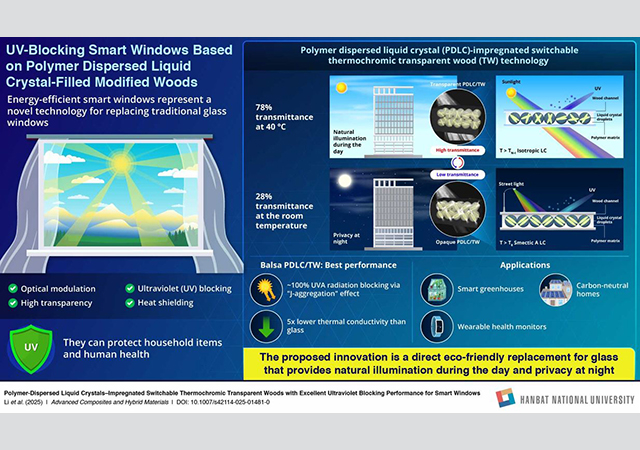
According to the study, the PDLC-impregnated transparent wood switches from an opaque state at room temperature to a more transparent state at around 40 deg C. In laboratory tests, visible light transmittance increased from about 28 per cent to nearly 78 per cent at a wavelength of 550 nanometres, allowing natural daylighting while maintaining privacy.
The researchers also reported that the material blocks almost 100 per cent of ultraviolet-A radiation through a molecular “J-aggregation” effect, helping to protect occupants, interiors and furnishings from UV exposure without compromising visible light transmission.
Thermal performance tests showed the transparent wood had a thermal conductivity of approximately 0.197 W/m·K, nearly five times lower than that of standard glass, indicating significantly improved insulation performance.
“With a thermal conductivity of 0.197 W W/m·K , our novel bio-composite is nearly five times more insulating than conventional glass, significantly slowing heat loss or gain in buildings,” highlights Dr Jin Kim, Assistant Professor from the Department of the Department of Materials Science and Engineering at Hanbat National University.
He further points out the diverse potential applications of their work. “Our innovation is a direct, eco-friendly replacement for glass that provides privacy at night and natural illumination during the day while slashing HVAC energy costs. It is ideal for smart greenhouses to prevent crop scorching by automatically regulating sunlight and maintaining stable internal growing temperatures.
“Furthermore, the present technology is promising for the development of intelligent wearable health monitors. It can be used as a flexible skin patch that turns transparent when body temperature exceeds 38 deg C, providing an instant visual health alert without the need for batteries or electronics,” says Dr Kim.
The findings were published online on October 16, 2025, in Advanced Composites and Hybrid Materials. The researchers said further work would focus on scalability, durability and integration with existing building systems.
If commercialised, the technology could support efforts to deliver lower-carbon buildings by replacing power-dependent smart glazing systems with bio-based, self-regulating materials, the team said.