











The Council on Tall Buildings and Urban Habitat (CTBUH) has announced the winners and finalists for the CTBUH 2016 Tall Building Awards. This year saw some of the most forward-looking entries yet, with 132 submissions vying for recognition.
The CTBUH Tall Building Awards are an independent review of new projects, judged by a prestigious panel of experts.
The awards aspire to provide a more comprehensive and sophisticated view of these important structures, while advocating for improvements in every aspect of performance, including those that have the greatest positive impact on the individuals who use these buildings and the cities they inhabit, said the organisers.
This year’s winners and finalists have set a new bar for the annual awards program, with many employing inventive solutions that respond to demanding site constraints and prerogatives related to sustainability, seismicity, wind forces, mixed functionality, and a vibrant urban habitat. Others achieve unrivaled iconicity, while introducing groundbreaking structural solutions and spatial arrangements at height, it stated.
Award recipients have been recognized across five categories: Best Tall Building Awards – Regional (Americas, Asia & Australasia, Europe, and Middle East & Africa), Urban Habitat Award, Innovation Award, Performance Award, and 10 Year Award. Additionally, the Council awards two Lifetime Achievements awards. The recipients of the Lynn S. Beedle Lifetime Achievement Award and the Fazlur R. Khan Lifetime Achievement Medal will be announced at a later date.
All award winners will be recognized at the CTBUH 15th Annual Awards Symposium, which will take place at the Illinois Institute of Technology, Chicago, on November 3.
The symposium will be followed by the Awards Ceremony & Dinner in the iconic Crown Hall. At the event, the four regional Best Tall Building winners will compete for the title of Best Tall Building Worldwide, as determined by the Awards Jury on the night.
Best Tall Building Awards
This category recognizes projects that have made extraordinary contributions to the advancement of tall buildings and the urban environment, and that achieve sustainability at the highest and broadest level.
The winning projects exhibit processes and innovations that have added to the profession of design and enhance the cities and the lives of their inhabitants. The Best Tall Buildings have been named for each of four competing regions in the world, from nominees representing a total of 27 countries.
Twelve finalists are also recognized as exemplary projects that were among the top candidates under consideration for winner status in each category.
*Best Tall Building Americas Winner
VIA 57 West, accomplishes the ambitious goal of forging an entirely new high-rise typology. Coined by the architect as a “courtscraper,” the tower is a hybrid between the European perimeter block and the traditional Manhattan high-rise, while combining the advantages of both.
It has the compactness, density, and intimacy of a classic courtyard building with the grandeur, airiness, and expansive views of a skyscraper. The building offers a unique vision for the future of the tall building; one that manages to synthesize high-quality and visually appealing architecture with the needs of the client, all without sacrificing environmental performance or residential quality. See the building profile on The Skyscraper Center.
“VIA 57 West is an inspired hybrid of the traditional courtyard block and high-rise tower. Its complex and intelligently orientated architecture maximizes occupants’ views to the Hudson River and activates the New York City waterfront with a dynamic new standard for integrated urban infill development.”
Michael Palladino, the juror, design partner, Richard Meier & Partners Architects, Los Angeles, VIA57West-Secondary
*Best Tall Building Asia & Australasia Winner
Shanghai Tower, embodies a new prototype for tall buildings. Placed in close proximity to Jin Mao Tower and Shanghai World Financial Center, the tower rises high above the skyline, its curved façade and spiraling form symbolizing the dynamic emergence of modern China.
But its twisting form goes beyond just creating a unique appearance; wind tunnel tests confirm a 24 percent savings in structural wind loading when compared to a rectangular building of the same height.
The tower’s program is organized into nine vertical zones. Each of these vertical neighborhoods rise from a sky lobby, a light-filled garden atrium that creates a sense of community and supports daily life with a varied program catering to tenants and visitors. See the building profile on The Skyscraper Center.
“Shanghai Tower shows the greatest commitment to communal space in a tall building since Commerzbank Tower completed in 1997. It contains the world’s first truly ‘inhabitable’ double-skin façade on a skyscraper, which is not only remarkable for its intended greenery, but its incorporation into the tower’s overall ventilation strategy. The sacrifice of valuable floor area to realize this social amenity proves that the aspirations for Shanghai Tower went far beyond mere commercial gain.”
Antony Wood, the juror, executive director, CTBUH, Chicago ShanghaiTower-Secondary
*Best Tall Building Europe Winner
The White Walls has single-handedly transformed the urban silhouette of Nicosia, the capital of Cyprus, drawing upon its context to deliver a residential-office tower that is unmistakably Mediterranean, yet global influential with its highly successful environmental considerations.
The mass of the tower’s white concrete walls is negated by numerous square perforations, from which an assortment of hanging vegetation protrudes. Abundant greenery is also present on its southern balconies, with native plants covering nearly 80 percent of the façade area. The resulting coverage serves to trap carbon dioxide, emit oxygen, and provide energy-saving shade. See the building profile on The Skyscraper Center.
“The White Walls is a truly groundbreaking exercise in materiality, serving as a successful expression of the architectural and environmental values of the Mediterranean across the vertical axis. Extensive vegetation on the north façade and the presence of loggias on the south façade create a very real connection with nature, while the tower’s punctured concrete walls quite literally ‘bleed green’ with tangles of local plant species.”
Karl Fender, jury chair, director, Fender Katsalidis Architects, Melbourne WhiteWalls-Secondary
*Best Tall Building Middle East & Africa Winner
The Cube, employs a residential design concept that is simple yet extraordinarily effective, rotating and displacing volumes on each floor to offer residents unique outdoor areas and panoramic views of Beirut.
The design stacks 14 rotated floor plans on top of a lobby, generating 21 apartments with fluid spaces, large balconies, and wall-to-wall window frames. The structure is unique for utilizing Self-Consolidating Concrete, allowing loads to be directed to four areas of rotated girders on every floor, with no additional structural slabs added to the façades. See the building profile on The Skyscraper Center.
“The Cube indicates a clear alternative to the extruded box typology that defines the majority of residential high-rises around the world, instead comprising a stack of completely unique villas in the sky. The tower is particularly successful in its structural design, which features a system of elegantly framed girder walls that add visual flair and allow for completely unobstructed floor plans.”
Hashimah Hashim, juror, executive director, KLCC Property Holdings Berhad, Kuala Lumpur
The Cube-secondary
*Best Tall Building Americas Finalists
432 Park Avenue, New York City, pushes the skyscraper typology to new extremes with a 1:15 slenderness ratio. Its outward simplicity belies a structural complexity that incorporates high-strength concrete and manifold lateral load reduction strategies.
The Tower at PNC Plaza, Pittsburgh, sets a new benchmark in sustainability and performance, both for the building itself and people who use it, employing such measures as natural ventilation, optimal solar orientation, water recycling, and waste diversion.
Torre Reforma, Mexico City, is a dramatic departure from the existing high-rise architecture of Mexico City. Breaking from this mold has resulted in a versatile, column-free building that incorporates natural energy reducing elements and a structurally expressive exterior.
*Best Tall Building Asia & Australasia Finalists
Beijing Greenland Dawangjing Tower, Beijing, features an alternating pattern of extruding and receding trapezoidal modules. These modules function like prisms, catching daylight and refracting it to create an interesting interplay of light and shadow.
Jiangxi Nanchang Greenland Central Plaza, Nanchang, has proven that the strategy of cold bending glass panes can be used to mitigate cost, fabrication, construction, and long-term durability factors traditionally associated with all-glass tower façades.
Shinsegae International, Seoul, is characterized by a tightly spaced metal grid that expresses the structural fidelity of the building, while evoking a sense of woven material in a nod to the fashion industry and the design imperatives of the primary tenant.
SkyHabitat
SkyHabitat, Singapore, comprises two stepping towers that are linked by three vegetated sky bridges. The towers’ open-to-above terraces cantilever two meters in all directions, providing shade to the windows of the unit below. The project is also recognized as an Urban Habitat Award Finalist for its robust social amenities.
South Beach, Singapore, reinterprets the Singaporean ideal of the “city in a garden” and applies it to the high-rise form through the presence of densely planted sky gardens and an expansive landscaped public avenue at ground level, referred to as the “green spine.”
*Best Tall Building Europe Finalists
Allianz Tower, Istanbul, was inspired by myriad spheres of cultural reference. The tower-like habitations emerging from rock formations in Central Turkey were heavily influential, while the Islamic obsession towards ornament was likewise of interest.
Allianz Tower, Milan, conveys both a sense of lightness, with its elegant structural glass fins that undulate softly up the tower, and solidity, employing four large steel buttresses that dramatically reduce wind-induced horizontal accelerations.
ECB – European Central Bank, Frankfurt, achieved prominence through its grand atrium, visible steel structure, and clear dialogue with the important urban reference points in Frankfurt, Germany: the Alte Oper, the Museumsufer, and the financial district.
Grattacielo Intesa Sanpaolo Torino, Turin, represents a crossroads of environmental and social well-being, as evidenced by its double-skin façade, which maximizes energy performance and allows light into the tower’s numerous communal spaces.
*Best Tall Building Middle East & Africa Finalists
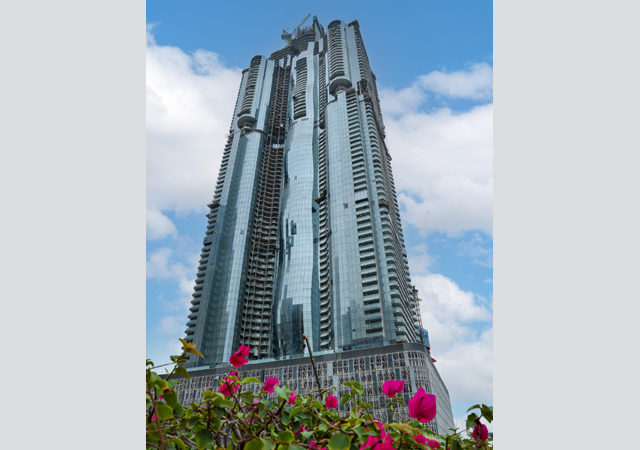
Iris Bay, Dubai, is characterized by a distinctive oval shape that limits solar exposure and creates areas of negative pressure throughout the structure, serving to draw air through the building and reduce dependence on mechanical ventilation.
*Urban Habitat Award
This award acknowledges that the impact of a tall building is far wider than just the building itself, and recognizes significant contributions to the urban realm in connection with tall buildings. Awardees range from brilliantly executed master plans that have led to quality urban environments, down to the scale of a single site, where the interface between a tall building and the urban realm is exemplary.
These projects demonstrate a positive contribution to the surrounding environment, add to the social sustainability of both their immediate and wider settings, and represent design influenced by context, both environmentally and culturally.
*Urban Habitat Award – Winner
wuhan_tiandiwuhan_tiandi
Wuhan Tiandi Site A, is an exemplary urban regeneration master plan that has transformed an underutilized dilapidated district into a true metropolitan community.
Located in the Wuhan core area, its ethos is to establish a compact, sustainable, transit-oriented, pedestrian friendly community with walkable blocks and courtyard housing, elements rarely seen in new developments throughout China.
The urban form integrates buildings of different heights to create spatial and visual interest. Towers are placed in strategic locations within the community, capitalizing on views of the Yangzi River, and creating valuable settings for landmark towers. The remaining site area is dedicated to an elaborate connective tissue comprising low- and mid-rise blocks, public spaces, and landscaping.
“The Wuhan Tiandi Mixed-Use Development demonstrates that a master plan for a tall building neighborhood can include vibrant public spaces that offer a high level of intimacy, walkability, and social design. The disposition of tall buildings combined with an animated public realm creates a vibrancy that is rarely found in newly created communities. The Wuhan Tiandi complex offers a high quality of life for those that live, work, and visit – a quality of life that rivals long established tall building neighborhoods found elsewhere in the world.”
James Parakh, juror, urban design manager, City Planning Department, Toronto
*Urban Habitat Award – Finalists
One Shenzhen Bay (Phase I), Shenzhen, incorporates an assemblage of ground planes and terraces that bring greenery and a sense of integration to higher levels. Water features and seating areas create tranquil outdoor spaces for informal social encounters and private respite.
SkyHabitat, Singapore, advances the concept of urban habitat with two stepping towers that are linked by three bridging sky gardens, creating a series of interconnected streets, gardens, and terraces in the air, with a variety of areas for common recreation and congregation.
SkyVille @ Dawson, Singapore, its central innovation is the public, external, shared spaces interwoven through the cluster of towers from the ground to the roof. Each home is part of a “Sky Village” comprising 80 homes that share a sheltered community garden terrace.
Toranomon Hills, Tokyo, is pioneering for how it resolves the high-rise condition with an arterial road running through the site. It does this by layering tiers of urban activity into the complex, with a large green space above the road and a primary thoroughfare below.